09 enero 2018

¿Están caras las bolsas?

Ni lo dudes… Por valoraciones no recomendaría a nadie comprar casi nada. Pero el juego de los mercados de valores es como una cuerda que se estira y que se estira, como un producto que se pone de moda y todo el mundo lo quiere y no para hasta que lo consigue… Es decir, que aún estando caras, pueden llegar a estar mucho más caras…
"Existe la percepción de que la bolsa americana está sobrevalorada respecto a la europea lo que implicaría que los mayores riesgos de corrección están en EEUU. Es cierto que el PER del S&P 500 (18,5x) es superior al del Eurostoxx 50 (15,5x) pero esta comparación sin más puede resultar engañosa", afirma Nicolás López de M&G A.V. que añade: "La composición sectorial es diferente por lo que para hacer una comparativa más correcta habría que ajustar de alguna forma la diferente composición. Tiende a pensarse también que las megacompañías tecnológicas americanas que en buena medida explican el mejor desempeño de los índices americanos están muy sobrevaloradas."
En los gráficos siguientes trato de hacer una comparación de valores significativos de ambos mercados. En el eje horiozontal se recoge el beneficio neto de las empresas, en el vertical el PER y el tamaño de las burbujas es el valor de mercado de las compañías (que a su vez es el producto del PER por el beneficio neto). En el primer gráfico podemo ver que el nivel de PER de las grandes tecnológicas es similar al de compañías europeas de cre3cimiento como la tecnológica SAP o las de consumo Inditex, Louis Vuitton o L’Oreal, todas ellas con niveles de PER en la banda 20x-25x. Por otra parte, compañías de sectores más cíclicos tienen un niveles de PER en la banda 10x-15x tanto en EEUU como Europa. Tal vez la diferencia de valoración en sectores más acusada sería la de los bancos, bastante más “baratos” en Europa que en EEUU. La conclusión sería que no se aprecia una clara sobrevaloración de la bolsa americana por lo que una eventual corrección de ésta difícilmente no se trasladaría a Europa
Compañías EEUU (rojo) vs Eurozona (azul): los niveles de valoración son más parecidos que lo que refleja el PER de los índices.
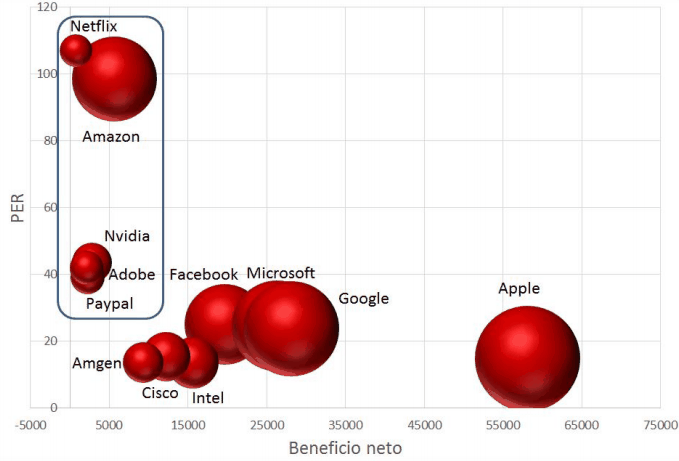
En el gráfico siguiente recogemos las 12 compañías más grandes del Nasdaq 100 que suponen un 60% de la capitalización del índice. Entre ellas sólo Amazon tiene un nivel de PER realmente estratosférico que el mercado justifica por su supuesto potencial de crecimiento futuro. Algunas otras con niveles de PER anormalmente elevados (Netflix, Nvidia, Adobe, Paypal) no tienen en conjunto el tamaño suficiente como para ser en sí mismas una amenaza para el mercado en caso de ajuste de valoración.
Tecnológicas americanas: sólo unas pocas de tamaño medio-grande tienen niveles de PER por encima de 25x.
Abrazos,
PD1: Cuando piensas en empresas tecnológicas, tu mente se va directamente a las FAANGs (Facebook, Apple, Amazon, Netflix, Google) yanquis, o a las BAT (Baidu, Alibaba, Tencent) chinas, ¿pero es que no hay empresas tecnológicas europeas? Pocas y de menor importancia…
When we think of tech giants, we tend to think of Silicon Valley.
And rightly so. California has given the world iconic digital brands like Facebook, Google and Uber.
The US leads the way both with listed tech giants and unicorns – privately held companies valued at $1 billion or more.
More than half of the world’s unicorns are based in the US, according to research firm CB Insights.
However, the US is still only one part of the global tech story.
China is home to some of the world’s largest tech companies: ecommerce giant Alibaba, search engine Baidu, and ride-sharing platform Didi Chuxing.
And Europe is also proving increasingly fertile ground for tech entrepreneurs.
The chart below shows some of its largest tech companies – both listed brands and unicorns:
Image: Statista
Scandinavian success
Although the UK is home to the largest cumulative value of $1 billion-plus tech firms in Europe, the continent’s biggest companies are found in Scandinavia.
Spotify is by far Europe’s most highly valued tech company. The Swedish music streaming service is reportedly being valued at around $16 billion. This makes it the most valuable music streaming service on the planet.
It is also the continent’s biggest unicorn – although it will lose that title if, as expected, it floats on the stock market with a valuation that some expect may reach $20 billion.
Spotify is one of three European tech companies to be valued at more than $10 billion by a report published in September called Europe’s Titans of Tech by investment firm GP Bullhound.
The exclusive $10 billion-plus club also includes German ecommerce firm Zalando, and Spotify’s Scandinavian neighbour Supercell.
Finland-based mobile gaming company Supercell is famous for such games as Clash of Clans. Last year Chinese tech group Tencent bought an 84% stake in the company, valuing Supercell at $10.2 billion.
UK hub
According to GP Bullhound, the UK is home is to nearly $50 billion-worth of $1 billion-plus tech companies, making it the epicentre of Europe’s digital revolution.
Its biggest listed tech company is online retailer ASOS, while CB Insights identifies the UK’s top unicorns as data centre provider Global Switch and online food delivery service Deliveroo.
In the World Economic Forum’s Global Competitiveness Report 2017-18, the UK is ranked 8th overall, thanks to its “technological readiness and the sophistication of its business sector”.
However, the report warns that the UK’s Brexit negotiations to leave the European Union could undermine its global competitiveness.
Freedom of movement for EU citizens forms a central part of the ongoing negotiations between the British government and the EU.
GP Bullhound’s report claims much of the UK’s tech success is due to London’s “gravitational pull” for entrepreneurs from across the continent.
This is backed up by the fact that of the 29% of tech founders in Europe who are expatriates, 60% chose the UK as the place to start up their business.
In total more than a third of European tech founders are based in the UK.
Y en España, ¿qué tecnológica tenemos? La de los taxis baratos, Cabify…, ¡qué cutres que somos!
PD2: Toda pelea de pareja debería resolverse quedándose en silencio y mirándose a los ojos, esperando a que uno de los dos se ría primero. Cuántos traumas nos ahorraríamos los seres humanos si antes de acostarnos dejamos solucionado el conflicto que haya tenido la pareja… Eso de pillar la cama y dejar para mañana verle la cara a tu mujer es de lo peor del mundo… Son esas cicatrices que no se curan y luego supuran.

08 enero 2018

Juan Ignacio Crespo

Estamos en un momento dulce, que se puede considerar una excepción…, no es lo que será lo habitual.
Juan Ignacio Crespo, matemático, analista y asesor del fondo Multiciclos Global FI de Renta4, habla del futuro de la actividad económica en una entrevista en Twecos de Crédito y Caución.
En ella, considera que la mayor amenaza que acecha al sistema financiero internacional es el “excesivo apalancamiento. Como en 2007, pero esta vez menos concentrado, pero mucho más distribuido entre los diversos agentes económicos y financieros. Algunas estrategias de gestión de activos podrían resultar peligrosas por ese apalancamiento. Se nota en que, de nuevo, las emisiones de deuda empresarial con muy escasas garantías y baja calidad crediticia están proliferando, a la vez que proporcionan rentabilidades muy poco por encima de las del Tesoro de Estados Unidos”.
Sobre la evolución del ciclo económico, dice que “existen numerosos indicadores, la mayor parte de ellos muy útiles, para intentar adivinar la deriva que va a tomar el ciclo económico; pero cada vez han ido tomando más peso los que se llaman índices de opinión, que no son otra cosa que opiniones de empresarios, inversores o consumidores recogidas por medio de una encuesta y organizadas de manera que la diferencia entre las diferentes percepciones recogidas -por ejemplo, si los empresarios van a contratar o no más empleados en los próximos meses- den una idea de si el ambiente económico apunta a una expansión de la economía o, por el contrario, a una contracción o decaimiento. A este tipo de resultados obtenidos de las encuestas se les suele llamar datos soft. El uso de estos indicadores trata de superar las dificultades que tiene el hacer previsiones económicas con lo que eran los datos más tradicionales, los que en la jerga anglosajona se llaman datos hard, que suelen llegar a analistas,  economistas y medios de comunicación con considerable retraso, dado el período de recogida y elaboración de la información que algo tan trabajoso requiere”.
Y añade que “en la actualidad estamos, probablemente, en un momento que se podría considerar excepción a alguna de las reglas establecidas en el punto anterior. Desde 1950 (tiempo para el que los datos son fiables) la economía de Estados Unidos ha entrado en recesión siempre que había un período prolongado de caída de precio de las materias primas y/o en que caían los beneficios de las empresas. Con una sola excepción: el período 1986-1987. En ese período no se produjo una recesión, aunque sí algo insólito y casi único en la historia conocida: un crac súbito de Bolsa, sin mayores consecuencias en términos de caída fuerte de la actividad económica. Pues bien, parece como si esa experiencia se fuera a repetir en la actualidad: tras uno de los períodos más largos conocidos de caída de precio de las materias primas y, también, con caída del ritmo anual de los resultados empresariales, es decir, una recesión de beneficios, la recesión en la economía de Estados Unidos no aparece, de momento, por ningún lado. Lo que es un alivio muy grande para la economía europea y, por ende, para la española que están viviendo un momento dulce desde hace tres años”.
Abrazos,
PD1: Soy seguidor y fan del Obispo Munilla, el Obispo de San Sebastian. He leído cosas que ha escrito, le he oído algún sermón en el Buen Pastor y se de la gran labor que hace allí con los jóvenes… Pero lo mejor es que escribe todos los días en twitter, y muchos tweets son muy buenos, me sriven para mi oración personal, me sirve para contarlos luego por ahí…:

05 enero 2018

el partido se tiene que acabar, pero ¿cuándo?

El Dow Jones alcanzó los 25K y esto está visto para sentencia… Ahora sólo falta por saber cuándo será… Según el New York Times:

After Dow 25,000, the Party Has to End. But When?

At over 3,000 days and counting, this bull market has been one of the longest on record, as the current eight-year run trails only the boom from 1987 to 2000.
In the midst of a long-running bull market that is now reaching momentous proportions, most investors may well have forgotten that just two years ago, during the first five trading days of 2016, the market dropped 6 percent. It was the worst five-day start to a year ever and supposedly a harbinger of bad times.
We know where that ended. Spurred by Donald Trump’s election that November, market indexes surged to record levels and went far higher this year. The Standard & Poor’s 500-stock index gained 19 percent in 2017, the Dow Jones industrial average rose 25 percent, and the technology-heavy Nasdaq composite leapt 28 percent.
There wasn’t a single day last year when the S.&P. 500 fluctuated more than 2 percent, a level of low volatility unseen since the mid-1960s, according to James Stack, a market historian and president of InvesTech Research.
In a rare convergence, investor euphoria spread across the globe. A measure of market performance, the MSCI All Country World Index, gained 22.7 percent last year, closing at a record high. And so far this year, stocks have continued their advance. On Thursday, the Dow broke the 25,000 barrier for the first time, and technology stocks are soaring to new highs. Cryptocurrencies like Bitcoin are adding a whiff of bubblelike mania.
And that may not be such good news for investors.
“If there are any certainties, one will be that this party will eventually come to an end,” Mr. Stack said. “A correction would be healthy. The longer we go without one, the greater the risk this will end badly. A lot of people will get hurt. And when it ends, it will end badly, and with high volatility.”
That doesn’t mean the end is imminent, according to Mr. Stack and other investment managers and market experts I interviewed this week. All of them successfully navigated markets last year, when the greatest risk was being underinvested.
“Everybody thinks the market is overvalued,” said Jerome L. Dodson, the founder and president of Parnassus Investments. “So do I. I’m expecting a correction, but I was expecting one after Trump was elected. I was wrong. The market can keep going up even when it’s overvalued.”
Mr. Dodson didn’t move into cash last year, and his Parnassus Endeavor Fund, where he’s the portfolio manager, gained nearly 20 percent last year and is ranked by Morningstar as the No. 1 fund in its category (large-cap growth) over three-, five- and 10-year periods.
“Most seasoned investors realize this market is overvalued and overbought and it’s been a long time since a normal correction,” Mr. Stack said. “They’re nervous.” Nonetheless, he said he was 82 percent invested in stocks, with 18 percent in cash, only slightly more than usual. He said he had learned from decades of market experience that “overvaluation isn’t what causes bear markets — it never has and never will.”
In addition, he said, “there’s going to be tremendous political pressure to keep the party going,” especially since Mr. Trump has so often cited the bull market as evidence of the success of his presidency.
So what should investors do?
It’s probably no surprise that Burton G. Malkiel, the renowned emeritus professor of economics at Princeton and author of the 1973 classic “A Random Walk Down Wall Street: The Time-Tested Strategy for Successful Investing,” recommends that investors “stay the course.”
“If the sharp rise in the stock market in 2017 has unbalanced your portfolio with a higher proportion of equities than is consistent with your risk tolerance, then you could do some rebalancing by trimming the equities down to the proportion at which you are comfortable,” Mr. Malkiel said. “But do not try to time the market. Nobody can consistently time the market, and those who try it usually fail.”
Although Mr. Malkiel is a longtime champion of passive, low-cost index investing, a strategy that has worked well since the financial crisis, last year he endorsed an “advanced indexing” approach at the automated investment manager Wealthfront, where he is chief investment adviser. Wealthfront aims to outperform strictly passive investing, and its taxable portfolio returned 20.56 percent last year, which indeed beat its benchmark.
Mr. Dodson is an active manager who focuses on stock selection. “I’ve never had a good record at market timing,” he said. “I look for stocks that are undervalued, but I’m having terrible trouble finding anything that’s reasonably priced.”
Technology stocks in general “are way overvalued,” he said. He has cut back on his fund’s large positions in Micron Technologies, Apple and Applied Materials after they notched big gains. With benefit of hindsight, he wouldn’t have sold them, “but someone once asked Bernard Baruch how he became so rich,” Mr. Dodson said. “‘I made my money by selling too soon,’” the famed financier replied.
Still, there are “a few” undervalued opportunities, Mr. Dodson said. He cited the health care sector: The biotech concern Gilead Sciences and the generic-drug maker Perrigo are two of his fund’s largest holdings. The toymaker Mattel “is on the bargain table,” he said. And even in technology, his fund has a large position in Qualcomm, currently fighting a takeover bid by the rival chip-maker Broadcom.
If so much is indeed overvalued, then this year’s market could well reward discerning active managers. “I worry about the index funds,” Mr. Dodson said. “They’re getting close to 25 percent in technology, given the high valuations and market caps. If there’s a reversal, it’s going to hit the index funds hard. This may finally be the year that active managers outperform.”
Mr. Stack agreed. “Active management isn’t about beating the market but about achieving market gains within a defined acceptance of risk,” he said. “There are selective opportunities, but you have to dig to find them. None are true bargains anymore.”
He recently bought shares in the diversified industrial manufacturer Ingersoll Rand and is moving his portfolio toward more defensive positions in consumer staples, energy and materials. “I’d rather be early with portfolio defenses and leave some profits on the table than go into a bear market fully exposed,” he said.
Mr. Stack said that in examining bull markets over the past 50 years, he had found that both the technology and energy sectors outperformed in the late stages of a bull market. He said investors “should have some portion of their portfolio in the materials sector, notably energy, which had been so out of favor” until mid-2017.
In my outlook column last year, Damien Courvalin, head of energy research for Goldman Sachs’s Global Investment Research commodities team, was uncannily accurate in forecasting that oil prices would recover in 2017 and stabilize at $55 to $60 per barrel. (West Texas intermediate crude oil futures ended the year at $60.42.) So I asked him what his team was predicting this year.
“From a total-return perspective, it’s quite compelling to be invested in commodities,” he said — even though he doesn’t see oil prices rising much above current levels by year’s end. That’s because, thanks to the shale oil revolution, producers outside the Organization of the Petroleum Exporting Countries can easily ramp up production when prices are $60 to $65. But commodities investors can still make a profit, he said, by betting on stable to rising prices in the futures market.
Like Mr. Stack, Mr. Courvalin noted that commodities and energy typically do well in the late stages of an economic expansion. Non-energy commodities may do even better, since they have no equivalent to shale and mining companies can’t increase production quickly in response to rising prices. In the mining sector, “margins are improving, orders are picking up, and we’re seeing new investment,” he said.
It may seem a paradox that investors’ worries about the coming year are mounting even as the economic outlook seems so bright. “Investors are struggling with this market because the skies are blue,” Mr. Stack said. “It’s rare when you have an investing climate like this one, where it’s all but impossible to find something to worry about, either domestically or globally.”
But that’s true in the late stages of most bull markets, he said, meaning investors need to be alert. And while virtually no one can foresee the next catalyst for a correction or bear market, even a hint that the Federal Reserve might raise interest rates more than expected would most likely set off seismic tremors.
“Most bull markets die by the sword of the Fed,” Mr. Stack said.
Abrazos,
PD1: Si pudiera convencerte de algo solamente, te diría que la vida es un servicio a los demás… En cuanto notes que estamos aquí para servir y no para ser servidos, entonces entrarás en otra dimensión…

03 enero 2018

2018 será el año que Facebook y Amazon lanzarán su banco

¿Habrá guerra comercial por los clientes de los bancos? ¿Será clave este 2018? Eso parece que nos e va a posponer mucho más. Ya hay ficha bancaria aprobada en muchos países, tienen la tecnología más que de sobra, y sobre todo, tienen una imagen de marca inmaculada, sin vincular con los errores de los banqueros en el pasado… Puede que me equivoque y no sea 2018, pero no falta mucho más. Facebook y Amazon van a volver a llevarse otro gato al agua, y este va a escocer a la banca en general…

Will 2018 Be the Year of the Bank of Amazon? Experts Weigh In

How Jeff Bezos Became the King of E-Commerce
For the financial technology industry, 2017 will be defined as the year that the threat of tech giants grew stronger, artificial intelligence cemented its importance and some startups applied to become banks.
What to look for in 2018? Maybe more mergers and acquisitions, initial public offerings and deeper forays by Amazon.com Inc. and Facebook Inc. Here’s a wrap from industry experts:

Payments

In the world of payments, all eyes are on the part of the ecosystem that helps retailers process card transactions. Incumbents like First Data Corp.Vantiv Inc. and JPMorgan Chase & Co.’s merchant services unit have long focused on winning business from large brick-and-mortar retailers, neglecting to spend a lot of time on the growing e-commerce sector. That’s made room for startups like Stripe Inc. and Adyen BV, which have garnered high valuations for doing just that. Now the questions are: What will be the next way that consumers make purchases and what will the incumbents do to catch up?
Matt Harris, Bain Capital Ventures: “SoftBank buys 20 percent of Stripe for $3 billion. PayPal continues to push itself down the path of being the leading financial services company for millennials and the mass market.”
Dion Lisle, Capgemini SA: “‘Alexa, buy this’ or ‘Siri, I need an Uber, pay for it with my AmEx.’ Payments are going to be activated by that voice because that’s a great security method.”

Lending

For investors in online lending, 2017 was the year of the shakeout. The companies that didn’t pay enough attention to underwriting were burned by losses, while longtime leaders like LendingClub Corp. and CAN Capital Inc. struggled with operational troubles and securing sufficient capital. Next year might not be any easier, according to experts. Banks have finally gotten their act together, and that means online lenders will increasingly have to compete against these large financial institutions.
Dan Ciporin, Canann Partners: “Scale is increasingly a competitive moat, with established players like LendingClub and SoFi now competing much more with bank offerings like Marcus from Goldman Sachs.”
Spencer Lazar, General Catalyst Partners: “Potential changes to the Consumer Financial Protection Bureau (CFPB) under the Trump Administration will likely turn back the clock on Obama-era regulations on non-bank lenders. This will be a boon to startup lenders, making it far easier to dole out capital. The fear is that rates could potentially become predatory.”

Amazon vs. JPMorgan

Retailers like Wal-Mart Stores Inc. have long wanted in on banking, and regulators might finally be on their side. That could open the door to a Bank of Amazon or a Facebook Financial. If these technology giants did decide to move into finance, they would have a few major advantages over the banks: better data, a superior user experience and immense customer loyalty.
Andy Weissman, Union Square Ventures: “Some combination of Amazon, Google, Facebook, Apple, etc. will move deeper into online financing of small businesses.”
Jeff Richards, GGV Capital: “Facebook has rolled out payments via Messenger to compete with Square Cash and Venmo, but hasn’t been super aggressive on this front. A ramped up effort in e-commerce could tie into an increased focus on payments.”
Jeremy Philips, Spark Capital: “The tech behemoths have been slow-ish but that’s changing quickly driven largely by Chinese chat/payments envy. Facebook and Apple and others will double down on trying to replicate this in the US.”

M&A

While some areas of fintech have seen consolidation, there’s still room for more. The maturing sector could see some combinations in areas such as lending, payments, personal financial managers and more.
Tyler Sosin, Menlo Ventures: “Stripe and Adyen will merge, forming a $20 billion plus enterprise-value business and API-driven merchant processor.”
Sean Park, Anthemis Group: “We think 2018-2019 might be the sweet spot for this since it’s part of a maturing ecosystem. In consumer finance, personal financial management and consumer lending, both could see a lot of combinations.”
Brendan Wallace, Fifth Wall Ventures: “Many generic online lending startups will fail or be acquired by large financial institutions at discount valuations.’’

Asset Management

The past 12 months have seen new hybrid versions of investing, pairing humans with the technology backing robo-advisers. Large banks are making moves, with Morgan Stanley and JPMorgan each announcing robo-adviser versions as a way to attract younger generations and create better user experiences.
While these moves add legitimacy to the startups, Wall Street could also simply turn around and duplicate them. Or, the banks could decide to partner with them as a way to beat the tech giants?
Kyle Lui, DCM Ventures: “Digital advice assets under management is estimated to hit $1 trillion by 2020. Traditional banks are waking up to this trend and viewing digital and robo-advisory products as a core part of their consumer growth strategy within asset management.”
Alois Pirker, Aite Group: “For startups in wealth management, it’s getting tough to differentiate yourself. I think you increasingly get beat with your own weapons since big firms can do this in greater varieties and have clients on board already.”

Funding

Venture capital-backed fintech companies raised $4 billion in the third quarter of 2017 alone, according to CB Insights. If the year’s current run rate holds steady in the last quarter, global fintech investment dollars and deal activity could hit records. And if that pans out, which areas should be seeing the most funding?
Alex Rampell, Andreessen Horowitz: “The first phase of fintech was ‘unbundling’ banks -- taking one of the features of a mega-bank, and doing it better. The next phase is rebundling -- adding other services, and cross-selling products (like SoFi starting in lending and later adding wealth and insurance). Venture capital will flow to successful startups moving into their second act of rebundling.”
Charles Birnbaum, Bessemer Venture Partners: “Valuations in the alternative-lending space were overly optimistic in our opinion over the prior five years, but we do feel that the pendulum has likely swung back too far in the other direction following the recent pullback” leaving the sector ripe for potential funding or M&A.
Abrazos,
PD1: Hoy te quiero presentar la cuenta de twitter de Arguments: https://twitter.com/Arguments Es un sitio que da formación, catequesis a quien se dedica a formar… Muy bueno!! Síguela, te encantará.
El mensaje de hoy es un buen ejemplo: “El fruto de la oración es la fe. El de la fe es el amor. El del amor el servicio. El del servicio, la paz”, Santa Teresa de Calcuta.
Todo con este orden: Oración, fe, amor, servicio, paz… Y yo añado alegría. Los más alegres de este mundo son los que han pasado por las 4 etapas anteriores… Es esa alegría de hacer lo que se debe de hacer, es una alegría de esperanza, de aceptar la voluntad divina…, de sabernos que somos sus hijos preferidos y muy amados.

02 enero 2018

resumen de 2017

Ha sido un año muy atípico, sin volatilidad, intervenidos por los bancos centrales, con una continuidad por el efecto Trump, con un desmadre de las FAANGs, sin corrección alguna… ¿Cómo será 2018? Dudo que sea una continuidad del pasado año. Habrá muchas más emociones…

LECCIONES DEL AÑO QUE ACABA

El análisis de la evolución de los mercados financieros y de los hechos que han influido en dicho comportamiento durante el ejercicio deja algunas enseñanzas:
-  Un año más los mercados financieros siguen intervenidos por la actuación de los bancos centrales. Sólo la intervención del BCE justifica los actuales tipos de interés de los bonos soberanos europeos. Países como España reciben dinero por endeudarse en emisiones hasta tres años. En el caso alemán, hasta vencimientos de ocho años. La presión sobre los tipos de interés de los bonos ha alcanzado a las emisiones de bonos corporativas. Incluso algunas empresas han logrado financiarse a tipos negativos.
-  La ausencia de rentabilidad en las emisiones de renta fija es tan acusada y la liquidez en busca de inversiones tan elevada, que incluso Argentina ha logrado emitir bonos a cien años, a pesar de haber impagado ocho veces en los últimos doscientos años.
-  La represión financiera seguirá presente, al menos, durante el próximo año. La rentabilidad sin riesgo es negativa. Los ahorradores e inversores más conservadores tendrán que asumir riesgo si desean lograr algo de rentabilidad. La rentabilidad media de los fondos monetarios en 2017 es del -0,25%. El propio BCE está fomentando la asunción de riesgos por personas y entidades que en muchos casos no están ni acostumbrados, ni preparados para soportar la eventual materialización de alguno de los riesgos asumidos. Los ahorradores siguen siendo los grandes damnificados de los tipos negativos.
-  La falta de volatilidad ha sido una constante en las bolsas. No se han producido prácticamente oportunidades de compra durante el año. La máxima caída desde los máximos no ha alcanzado ni el 3% en el S&P. Aunque ha sido superior en el Eurostoxx, no se han producido fuertes caídas en breves periodos de tiempo como otros años. El convencimiento de la actuación de los bancos centrales en caso de caídas bruscas, hace que los inversores compren antes en las correcciones.
-  Pase lo que pase, no pasa nada. Los mercados financieros han ignorado noticias que en situaciones normales habrían generado volatilidad y caídas de las cotizaciones: ni el rescate de la banca portuguesa; ni el rescate con dinero público de parte de la banca italiana, ni la caída del Banco Popular; ni la declaración de independencia del parlamento de Cataluña han causado caídas en los índices. Se ignoran los riesgos.
-  Aunque la inflación no haya hecho acto de presencia, el temor a la deflación ha desaparecido. Es el primer paso para un repunte de los índices de inflación. La reforma fiscal de EE.UU. podría ser el desencadenante de un incremento de la inflación.
-  La Reserva Federal es el único banco central que realmente está siguiendo la senda de normalización monetaria. Ya ha subido los tipos de interés en cinco ocasiones y ha comenzado a reducir su balance. Marca el camino al resto de bancos centrales, aunque con un elevado decalaje temporal.
-  A pesar de la fuerte subida de la bolsa norteamericana, con 70 máximos históricos del Dow Jones en el año, los ciclos no han desaparecido, nada sube permanentemente.
-  Las expectativas de crecimiento mundial son extraordinarias, con tasas de incremento superiores al 3,5%, sólo seis países en recesión y sin presiones inflacionistas. No obstante, los tipos de interés intervenidos anestesian el problema de la deuda global.
En definitiva, un año más la actuación de los bancos centrales ha sido fundamental, manteniendo los tipos de interés en mínimos históricos, incluso en negativo, e inyectando liquidez. La valoración de los activos financieros sigue distorsionada por su intervención.
Abrazos,
PD1: Si tu corazón está lleno de Dios no podrá entrar nada que te haga infeliz. Estos días de excesos, de consumismo, de frenesí…, el que piense que esto es la vida normal está muy equivocado. La gente normal y corriente nos dedicamos a trabajar, estudiar, criar a nuestros hijos y tratar de divertirnos haciendo feliz a los demás…, metiendo a Dios en nuestras cosas, sin dejarle fuera.