25 octubre 2014

27 octubre 2014 China sale de compras y se lo queda casi todo

El Presidente chino Li volvió a pasar por Europa hace unas semanas y llegó a acuerdos bilaterales con Italia por importe de €8,000 millones. Otros acuerdos recientes de China con Alemania han ascendido a €14,300 millones (incluyendo un ferrocarril que se va a construir que une Alemania y China), Francia €18,000 millones, España €3,150 millones. Poco en España, pero es lo que hay, no somos industriales y eso…
Como son muy poderosos, gracias a su nuevo poderío económico, lo que no tienen o lo copian, o se lo compran… Y su Presidente viaja a hacer negocios y acuerdos comerciales positivos para sus empresas…, igualito que aquí.
En casi un santiamén hemos pasado de los restaurantes y tiendas todo a cien a quedarnos poco menos que boquiabiertos con el lustre inversor chino, que tanto incluye a grandes fortunas privadas, poderosas empresas públicas o los fondos soberanos del propio gobierno. La combinación de grandes reservas de divisas, casi cuatro billones de dólares, el enorme ahorro acumulado, las necesidades de abrir nuevos mercados y adquirir capacidades indispensables para cambiar el modelo de desarrollo unido a las demandas inversoras de muchas empresas y gobiernos occidentales afectados por la crisis permiten concretar grandes operaciones en magnitudes y plazos a menudo vertiginosos.
Las autoridades orientales estiman que la inversión china en el extranjero crecerá en los próximos años a una tasa superior al 10%. En 2002 ascendía a 2.700 millones de dólares, pasando a 107.800 millones en 2013, situándose ya como la tercera economía del mundo por este concepto, tras EEUU y Japón. Este año podría ser el primero en que China invierte más en el exterior de lo que recibe.
Los frentes de actuación son variopintos como también las finalidades, unas veces de carácter estrictamente económico, otras vinculadas a objetivos estratégicos. En cualquier caso, cabe destacar las inmensas capacidades orientativas de las decisiones gubernamentales, ya nos refiramos a países o sectores.
China tenía invertida en agosto la cifra de 1,269 billones de dólares en bonos del Tesoro de EEUU, siendo el prestamista número uno de la primera economía mundial. También ha suscrito una parte significativa de la deuda española. Del sector energético, obviamente prioritario, evoluciona hacia ámbitos tecnológicos o consolida posiciones de peso a escala global en segmentos como el automóvil.  De Asia a África, el salto a los países desarrollados de Occidente crece en importancia a medida que también menguan las reservas y restricciones.
En otro orden, pero igualmente de alcance estratégico, cabe destacar la creciente internacionalización de la moneda china. Recientemente, el gobierno británico emitió por primera vez en Occidente bonos en yuanes por valor de 480 millones de dólares. En abril de este año, el yuan chino se convirtió en la séptima moneda más utilizada en pagos internacionales  y en 2013 ya se había convertido en la segunda moneda más usada en el comercio mundial, por delante del euro. Numerosas plazas se pelean en Europa y en el mundo por establecer mercados del yuan. El potencial de la moneda china como futura divisa de reservas parece estar fuera de cuestión.
Las empresas chinas, en gran medida públicas, aumentaron un 21,9 por ciento sus inversiones en el exterior en los primeros nueve meses del año. Es una tendencia al alza que cuenta con el decidido apoyo de su gobierno. Algunas de esas inversiones se orientan a adquisiciones totales o parciales de empresas en dificultades de Occidente.  Algo de ello hemos podido constatar en España. Otras se orientan a mejorar las infraestructuras básicas en condiciones bien accesibles, dando así salida a sus propios excesos de capacidad en un momento complejo de la economía china a pesar de sus envidiables, pero moderadas respecto a las habituales, tasas de crecimiento. Esa capacidad, desconocida en otros lares, consigue trazar rutas y corredores económicos no solo sobre el papel sino con disponibilidad para alterar la geoeconomía global.
Muchas de estas operaciones se concretan en el marco de giras de los líderes políticos. En la reciente visita del primer ministro Li Keqiang a Europa, los acuerdos firmados con Alemania, el único país que visitó dos veces desde que asumió el cargo el año pasado, equivalían a un monto de 18.100 millones de dólares y los firmados con Italia a más de 10.000 millones… En su visita a China, el monto de lo firmado por nuestro presidente Rajoy rondó los 4.000 millones, inferior a los 5.000 millones logrados por Zapatero en 2011.
En dicho contexto, pareciera que los datos dados a conocer por el FMI que sitúan a China como la primera economía del mundo en concepto de paridad de poder de compra no parecen disparatados. No obstante, conviene no perder de vista que en términos nominales aun le falta mucho para alcanzar a EEUU, unos 6,5 billones de dólares al menos. Por no hablar del índice del PIB per capita (posición 80) o en términos de IDH (casi 100) o magnitud de la pobreza (82 millones en 2013).
Ese retrato de conjunto nos muestra una potencia compleja, con muchas quiebras y desafíos aun en su desarrollo. Pero no cabe duda que los flujos de inversión china en el exterior aumentarán de forma exponencial en los próximos años en paralelo a la afirmación de su presencia a todos los niveles, monetaria incluida. La aceleración de ese proceso, acogido con notorio entusiasmo en algunas capitales europeas ampliamente movilizadas, amenaza con relegar a España a una posición periférica en tanto en cuanto los actores públicos y privados más directamente implicados no se sacudan esa cierta parálisis que condiciona nuestra capacidad de innovación, ya hablemos de lo económico pero también de lo político.
- since 2010, Chinese investment has been increasing in European European countries that needed to privatize quickly and at cheap price
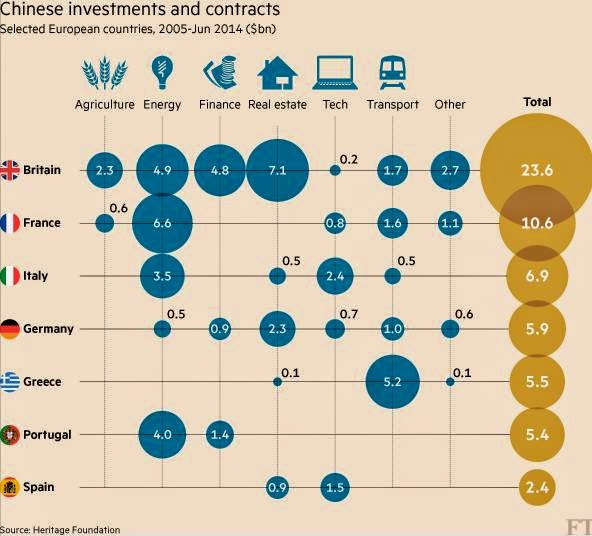
Last Tuesday, I posted about the increasing investment of China in Russia, wondering whether and to what extent it could help Russia smooth the economic impact of European sanctions. But as shown by a recent  analysis of the Financial Times, China has been increasingly investing in Europe as well, focusing recently on crisis-hit countries.
Chinese FDI to Europe has been very small until 2010. But since then it has been significantly increasing, reaching 27bn euro in 2012
China has traditionally been a receiver of European FDI, which according to Deutsche Bank, accounted for 18% of total China's FDI stock. On the contrary, Chinese FDI to Europe has been very small until 2010. But since then it has been significantly increasing, reaching 27bn euro in 2012. Even so, Chinese FDI still represents a minimal share (0.7%) of total FDI stocks that EU countries receive from non-EU countries.
EUROSTAT
Between 2008 and mid-2014, China sealed more than 200 cross-border M&A or joint venture deals in the EU
According to Deutsche Bank, between 2008 and mid-2014, China sealed more than 200 cross-border M&A or joint venture deals in the EU.  Most M&A projects were undertaken in the industrial sector, consumer products, energy and basic materials (figure 2, right). Deutsche Bank also highlights the existence of different strategies across destination countries: in Germany, deals appear to have been focused mostly on machinery, alternative energy, automotive parts and equipment; in France, the target was mostly consumer industries; while in the UK target industries reflect a broad-based mix.
Deutsche Bank
Germany attracted the largest number of deals (figure 2, left) - most notably Greenfield investments - followed by the UK and the Netherlands. Italy, Greece, Portugal and Spain, seem to have become more interesting to Chinese investors only from 2012 onwards.
Italy, Greece, Portugal and Spain seem to have become more interesting to Chinese investors only from 2012 onwards
The Financial Times published this week an analytical series ("Silk Road redux") that looks more into this new wave of Chinese FDI in crisis-hit European countries. Sources quoted in the articles suggest that with the 2010 European crisis, China has indeed started to shift its foreign investment focus from mostly natural resources-related investments in Africa, Asia and Latin America, towards assets in European countries that, at the height of the crisis, were often faced with the need to privatize quickly and at relatively cheap price (figure 3).
In Italy, the FT reports that at the end of 2012, an estimated 195 SMEs (with combined total revenues of €6bn and 10,000 employees) had been wholly or partly taken over by Chinese or Hong Kong investors. China managed to secure stakes in big companies as well. In July this year, Chinese State Grid invested heavily in the Italian power grid, buying 35% in CDP Reti. Safe in turn invested estimated 2 billions in ENI and ENEL, two state-controlled energy groups, while the state Administration of Foreign Exchange bought 2% stakes in FIAT Chrysler Automobiles, Telecom Italia and Prysmian, for a total of 670 million.
In Greece, Chinese investors are focusing on shipping and tourism. In June, Greece and China signed shipbuilding deals worth $3.2bn that will be financed by the state-owned China Development Bank. The Chinese state shipping group Cosco Pacific had already acquired a concession to operate in the Piraeus port back in 2009, and is competing to buy the 67% stake currently held by the Greek State. Greece's Transport ministry is also reportedly expecting China's State Construction Engineering Corporation to participate in a tender to build and operate a new 800 million euro airport in Crete, which could offer the first direct connection between China and Greece. Chinese tourists are increasing in Greece, and (in 20 years time) they could possibly enjoy the huge luxury commercial centre that will be built on the coastal site of the former Athens airport. A long-term project worth 5 billion in which Chinese Fosun is participating together with Greece and Gulf state partners.
Financial Times
In Portugal, Chinese investment is reported to account for 45% of the total privatization conducted in the context of the EU/IMF programme
In Portugal, Chinese investment is reported to account for 45% of the total privatization conducted in the context of the EU/IMF programme. Chinese early investments were in power utility and infrastructure, with Three Gorges Corporation acquiring in 2011 a stake of 21% in Energias de Portugal and China State Grid acquiring 25% of REN, the national grid operator. In 2014, instead, investment was concentrated in financial services, with Fosun buying 80% of the Portuguese Caixa Seguros, the largest insurance company, and now bidding for BES assets.
On top of these investments, Chinese buyers are potentially revitalising the otherwise paralysed real estate market in crisis-hit countries. The FT reports that government of Portugal, Cyprus, Greece, Hungary, Latvia and Spain are managing to attract Chinese real estate buyers by offering residency permits to non-Europeans who buy local property of a certain amount. The practice is known under the name of "golden visas". In Portugal, the golden visa requires buying a property for at least 500,000 euros, the same in Spain (which is at present reported to have 500 application pending) whereas in Greece and Hungary it takes a 250,000 sale. Portugal is reportedly the country where the scheme has been more successful, with 1360 visa issued (81% of which to Chinese nationals) and an associated 900 million real estate investments (forecasted to reach 2 billion by end-2015).
Despite the recent increase, Chines FDI to Europe are still in an infancy state and more data will be needed before drawing conclusion on whether this can qualify as a meaningful trend. But it looks like the euro crisis might have opened to China the doors of otherwise locked European investments.
Abrazos,
PD1: China: El 45% de su población vive en zonas rurales. Se espera que 300 millones pasen a vivir en ciudades en los próximos 20 años... Mucho por hacer… Esa sensación de crisis inmobiliaria allí yo no la tengo.
¿Dónde han invertido los chinos en Real Estate en EEUU:
PD2: Inflación: OK
Y las previsiones de Goldman Sachs son buenas también:
Retail Sales:
Inversión en activos fijos:
Exportaciones:
Divisa y reservas:
PD4: Interesante aplicación que da BlackRock para estudiar los mercados en función de sus parámetros: http://www.blackrockblog.com/blackrock-emerging-market-marker/
PD5: Que es lo que hacemos los 7.000 millones de personas que habitamos el planeta Tierra:
Y dónde viviremos:
¡Qué horror!
China es muy disperso y su riqueza se concentra en pocos sitios: Aquí en naranja la mitad de su PIB:
PD6: Me muero por hacer… Siempre deseamos hacer cosas y no las hacemos… Esas ilusiones muertas, ese querer hacer y no poder…caray, esas prisas!!!, ¿No estaremos perdiendo la vida sin hacer lo que queremos?
Aunque posiblemente no hagamos, al menos yo no lo hago, el hacer lo que debamos: querer más a los otros y menos a uno mismo, a mí mismo.

22 octubre 2014

22 octubre 2014 Lamentable...

Lamentable los últimos datos de exportaciones de España. Íbamos a salir de la crisis gracias a que exportábamos que te cagas…
Lamentable la mora bancaria. ¿Habrá más oculta?
Lamentable la evolución del crédito en España: no se pide porque ¿no se sabe en dónde invertir, no se atreven los empresarios, o no se conceden más créditos…?
Lamentable lo mal que salimos si nos comparamos en las estadísticas del paro y del paro juvenil:
Lamentable saber que nuestro negocio de aceite de oliva, que exportamos mucho fuera, sea comprado por los italianos, lo embotellen y lo vendan ellos a los chinorris mucho más caro… Indecente. ¿Por qué no lo embotellamos nosotros y se lo vendemos a los chinos nosotros mismos?
Y cachondo que con todos estos problemas tengamos estos tipos de interés:
Cachondo que con las palabras de Dragui aquél lejano mes de julio de 2012 donde dijo que haría lo que hiciera falta sin escatimar medios, nos permitirera salir del hoyo, sin que ellos se gastaran un chavo…
Lamentable que los datos españoles de ahorro e inversión sigan estos derroteros. Los españoles tiran de ahorros para vivir. Y no invierte nadie. Cuando para que la economía crezca lo debe hacer por dos frentes, por el consumo y exportaciones, o por el del ahorro y la inversión… Ahora crecemos porque tiran las importaciones, el consumo y el gasto público. Es genial, menuda mierda de crecimiento vamos a tener… Pan para hoy y mucha hambre mañana…
Lamentable que las deudas de nuestro sector exterior sean tales que nos generen una lacra para salir de la crisis. No mejoran pasen los años que pasen…
Lamentable que les sigamos debiendo tanto a los alemanes, aunque, gracias a Dios, ¡qué paciencia tienen con sus deudores…!
Lamentable que la única salida que les queda a nuestros jóvenes sea largarse de España:
Lamentable que no se vea ningún repunte en el mercado inmobiliario, a pesar de esos mensajes de siempre de que los pisos han tocado suelo. Ni por stock, ni por demografía…, no habrá repunte desde el hoyo que alcance dentro de unos años…
Lamentable el derroche y los riesgos nacionalistas, secesionistas, financiados por el Estado. Deuda de Cataluña: suma y sigue… ¿hasta cuánto subirá? ¿Lo podemos pagar todo? ¿No es un disparate dejarles a los que vienen detrás todas estas deudas?
Lamentable vernos atados de pies y manos. Los políticos no pueden hacer casi nada… Todo se centra en 5 partidas y las pensiones se comen 4 de cada 10 euros de los Presupuestos Generales del Estado… Lamentable ver que los intereses de la deuda representan 35.000 millones de euros cuando hace poco pagábamos sólo 20.000 millones. Lamentable ver la factura creciente de pensiones… En unos años no la podremos pagar: crece y crece y sigue creciendo… se come todo.
Lamentable que las cosas básicas que gastamos suban mucho más que la inflación. Por ponerte un ejemplo nimio: mira el abono de transportes de Madrid comparado con el IPC:
Lamentable que las diferentes políticas monetarias entre ambos bloques hayan degenerado en esto:
Y lamentable que las previsiones de meternos en una tercera recesión sean mayores para la UE:
Lamentable que seamos tan poco apetecibles para querer nacer en este país:
Y por último, lamentable que los casos de corrupción, despilfarro y derroche siga siendo el pan nuestro de cada día… ¿No tendrá esto la culpa? Esto y un estado lleno de empresas públicas, verdadero empresa estatal de empleo, donde se colocan a todos los que han gestionado la “res publica”
Así que vamos bien…, estamos que nos salimos, mejor que nunca, salimos de la recesión, pero salimos peor de cómo entramos, sin purga y dejando a las siguientes generaciones una lacra insalvable. Lamentables abrazos y por favor, no me mandes un email diciendo que estoy muy pesimista, que debería ser más optimista, que ya lo sé…
PD1: Lamentable que la vida pasa, la tecnología mejora…, y así andamos, más gordos y más viejos…
Es lamentable que lo único que hace el españolito medio es darle gusto a la barriga, tirarse pegado a una pantalla todo el día, machacarse en el gimnasio para parecer atlético…
¡Joder, cambia, no seas como los del montón, se distinto, haz algo bueno por los demás, ayuda, quiere más al otro y no a ti mismo!

21 octubre 2014

21 octubre 2014 El fin de otro Imperio

Estamos viendo cómo cambian las tornas entre los EEUU y los chinos…
Hemos visto desde nuestra infancia el poderío de los norteamericanos que han liderado el devenir del mundo conocido… Pero la crisis, el exceso de deudas, el consumismo exacerbado…, ha hecho que ahora se mire hacia Oriente, que lo tiene todo por hacer… Es la diferencia de un país con deuda externa y otro sin problema de financiación externa:
En los últimos años hemos visto como los BRICs ganaban el pulso del crecimiento a los países ricos…
History did not end with the Cold War and, as Mark Twain put it, whilst history doesn’t repeat it often rhymes. As Alexander, Rome and Britain fell from their positions of absolute global dominance, so too has the US begun to slip. America’s global economic dominance has been declining since 1998, well before the Global Financial Crisis. A large part of this decline has actually had little to do with the actions of the US but rather with the unraveling of a century’s long economic anomaly. China has begun to return to the position in the global economy it occupied for millenia before the industrial revolution. Just as the dollar emerged to global reserve currency status as its economic might grew, so the chart below suggests the increasing push for de-dollarization across the 'rest of the isolated world' may be a smart bet...
As Deutsche Bank's Jim Reid explains,
In 1950 China’s share of the world’s population was 29%, its share of world economic output (on a PPP basis) was about 5% (Figure 98). By contrast the US was almost the reverse, with 8% of the world’s population the US commanded 28% of its economic output.
By 2008, China’s huge, centuries-long economic underperformance was well down the path of being overcome (Figure 97).
Based on current trends China’s economy will overtake America’s in purchasing power terms within the next few years. The US is now no longer the world’s sole economic superpower and indeed its share of world output (on a PPP basis) has slipped below the 20% level which we have seen was a useful sign historically of a single dominant economic superpower. In economic terms we already live in a bipolar world. Between them the US and China today control over a third of world output (on a PPP basis).
However as we have already highlighted, the relative size of a nation’s economy is not the only determinant of superpower status. There is a “geopolitical” multiplier that must be accounted for which can allow nations to outperform or underperform their economic power on the global geopolitical stage. We have discussed already how first the unwillingness of the US to engage with the rest of the world before WWII meant that on the world stage the US was not a superpower inspite of its huge economic advantage, and second how the ability and willingness of the USSR to sacrifice other goals in an effort to secure its superpower status allowed it to compete with the US for geopolitical power despite its much smaller economy. Looking at the world today it could be argued that the US continues to enjoy an outsized influence compared to the relative size of its economy, whilst geopolitically China underperforms its economy. To use the term we have developed through this piece, the US has a geopolitical multiplier greater then 1, whilst China’s is less than 1. Why?
On the US side, almost a century of economic dominance and half a century of superpower status has left its impression on the world. Power leaves a legacy. First the USA’s “soft power” remains largely unrivalled - US culture is ubiquitous (think McDonald’s, Hollywood and Ivy League universities), the biggest US businesses are global giants and America’s list of allies is unparalleled. Second the US President continues to carry the title of “leader of the free world” and America has remained committed to defending this world. Although more recently questions have begun to be asked (more later), the US has remained the only nation willing to lead intervention in an effort to support this “free world” order and its levels of military spending continues to dwarf that of the rest of the world. US military spending accounts for over 35% of the world total and her Allies make up another 25%.
In terms of Chinese geopolitical underperformance there are a number of plausible reasons why China continues to underperform its economy on the global stage. First and foremost is its list of priorities. China remains committed to domestic growth above all other concerns as, despite its recent progress, millions of China’s citizens continue to live in poverty. Thus so far it has been unwilling to sacrifice economic growth on the altar of global power. This is probably best reflected in the relative size of its military budget which in dollar terms is less than a third the size of Americas. Second China has not got the same level of soft power that the US wields. Chinese-style communism has not had the seductive draw that Soviet communism had and to date the rise of China has generally scared its neighbors rather then made allies of them. These factors probably help explain why in a geopolitical sense the US has by and large appeared to remain the world’s sole superpower and so, using the model of superpower dominance we have discussed, helps explain why global geopolitical tensions had remained relatively low, at least before the global financial crisis.
However there is a case to be made that this situation has changed in the past five or so years. Not only has China’s economy continued to grow far faster than America’s, perhaps more importantly it can be argued that the USA’s geopolitical multiplier has begun to fall, reducing the dominance of the US on the world stage and moving the world towards the type of balanced division of geopolitical power it has not seen since the end of the Cold War. If this is the case then it could be that the world is in the midst of a structural, not temporary, increase in geopolitical tensions.
Why do we suggest that the USA’s geopolitical multiplier, its ability to turn relative economic strength into geopolitical power, might be falling? Whilst there are many reasons why this might be the case, three stand out. First, since the GFC the US (and the West in general) has lost confidence. The apparent failure of laissez faire economics that the GFC represented combined with the USA’s weak economic recovery has left America less sure then it has been in at least a generation of its free market, democratic national model. As this uncertainty has grown, so America’s willingness to argue that the rest of the world should follow America’s model has waned. Second the Afghanistan and in particular the Iraq War have left the US far less willing to intervene across the world. One of the major lessons that the US seems to have taken away from the Iraq war is that it cannot solve all of the world’s problems and in fact will often make them worse. Third, the rise of intractable partisan politics in the US has left the American people with ever less faith in their government.
The net result of these changes in sentiment of the US people and its government has been the diminishment of its global geopolitical dominance. The events of the past 5+ years have underlined this. Looking at the four major geopolitical issues of this period we raised earlier – the outcome of the Arab Spring (most notably in Syria), the rise of the Islamic State, Russia’s actions in Ukraine and China’s regional maritime muscle flexing – the US has to a large extent been shown to be ineffective. President Obama walked away from his “red line” over the Syrian government’s use of chemical weapons. The US has ruled out significant intervention in Northern Iraq against the Islamic State.
America has been unable to restrain Pro-Russian action in Ukraine and took a long time (and the impetus of a tragic civilian airplane disaster) to persuade her allies to bring in what would generally be considered a “first response” to such a situation - economic sanctions. And so far the US has had no strategic response to China’s actions in the East and South China seas. Importantly these policy choices don’t necessarily just reflect the choice of the current Administration but rather they reflect the mood of the US people. In Pew’s 2013 poll on America’s Place in the World, a majority (52%) agreed that “the US should mind its own business internationally and let other countries get along the best they can on their own”. This percentage compares to a read of 20% in 1964, 41% in 1995 and 30% in 2002.
The geopolitical consequences of the diminishment of US global dominance
Each of these events has shown America’s unwillingness to take strong foreign policy action and certainly underlined its unwillingness to use force. America’s allies and enemies have looked on and taken note. America’s geopolitical multiplier has declined even as its relative economic strength has waned and the US has slipped backwards towards the rest of the pack of major world powers in terms of relative geopolitical power.
Throughout this piece we have looked to see what we can learn from history in trying to understand changes in the level of structural geopolitical tension in the world. We have in general argued that the broad sweep of world history suggests that the major driver of significant structural change in global levels of geopolitical tension has been the relative rise and fall of the world’s leading power. We have also suggested a number of important caveats to this view – chiefly that a dominant superpower only provides for structurally lower geopolitical tensions when it is itself internally stable. We have also sought to distinguish between a nation being an “economic” superpower (which we can broadly measure directly) and being a genuine “geopolitical” superpower (which we can’t). On this subject we have hypothesised that the level of a nations geopolitical power can roughly be estimated multiplying its relative economic power by a “geopolitical multiplier” which reflects that nations ability to amass and project force, its willingness to intervene in the affairs of the world and the extent of its “soft power”.
Given this analysis it strikes us that today we are in the midst of an extremely rare historical event – the relative decline of a world superpower. US global geopolitical dominance is on the wane – driven on the one hand by the historic rise of China from its disproportionate lows and on the other to a host of internal US issues, from a crisis of American confidence in the core of the US economic model to general war weariness. This is not to say that America’s position in the global system is on the brink of collapse. Far from it. The US will remain the greater of just two great powers for the foreseeable future as its “geopolitical multiplier”, boosted by its deeply embedded soft power and continuing commitment to the “free world” order, allows it to outperform its relative economic power. As America’s current Defence Secretary, Chuck Hagel, said earlier this year, “We (the USA) do not engage in the world because we are a great nation. Rather, we are a great nation because we engage in the world.” Nevertheless the US is losing its place as the sole dominant geopolitical superpower and history suggests that during such shifts geopolitical tensions structurally increase. If this analysis is correct then the rise in the past five years, and most notably in the past year, of global geopolitical tensions may well prove not temporary but structural to the current world system and the world may continue to experience more frequent, longer lasting and more far reaching geopolitical stresses than it has in at least two decades. If this is indeed the case then markets might have to price in a higher degree of geopolitical risk in the years ahead.
Abrazos,
PD1: Esto es lo que ha ocurrido en los últimos 140 años. ¿Qué pasará en los próximos 30?
While it's not always the best indicator of what's going to happen in the future, it can be helpful to look at what long-term trends in growth tell us about how the global economy has developed over time.  Using a data set put together by the Maddison Project, we are able to see some interesting trends over the long arc of economic history and across countries.  The chart below shows the per capita GDP for a variety of countries over time, experessed in 1990 dollars.
Towards the end of the 19th century, the political power of the British empire started to decline, and with it the advantages for British subjects in the UK and Australia; these two started as the two most productive nations but had to play defense over the intervening period as other nations' growth rates caught up.  Central American countries have also had an interesting path.  While Venezuela started at a very low level of GDP, it was able to move up the ranks to number two in this sample by the late 1950s.  But since then, political decisions have hampered growth, and the nation now trails significantly.  Argentina was also a very productive society in the 1910s; unscathed by World War I, Argentines were the 4th most productive in the above sample by the time the Roaring Twenties kicked off.  But the Great Depression destroyed Argentina's open economy, and political issues in the 1970s again trashed growth.  Overall, the most glaring country on this chart is the United States, which has been able to grow from a relatively high base in 1870 to a drastically more productive economy than its peers.  Most of that outperformance accrued around World War II, but it's continued throughout the last 70 years.
Overall, prosperity today is relatively dependent on where prosperity sat in 1870.  The chart below compares 1870 and 2010 per capita GDP (again, constant 1990 dollars) for an even broader set of countries than the first chart.  While the US has grown faster than its initial starting point would suggest (as have Nordic countries and Canada), many of today's emerging markets have underperformed versus their starting base, as has New Zealand and to an extent the UK.
PD2: Son los países emergentes…
PD3: ¿La gente tiene esta mala leche? Es el egoísmo elevado a la máxima potencia… Ay del día en que dejemos de pensar en yo-me-mi-conmigo, y prestemos más atención al otro, al de al lado, al de enfrente…, a ese que no conocemos… Me enerva!!! Para lo único que sirve ver esto es para estar luego uno muy fino en lo que hace, en los detalles con los demás, con los de nuestro entorno, con la gente que trabajamos…