26 septiembre 2016

de nuevo los emergentes de moda

Llevan un buen año… De nuevo les vuelve a entrar dinero.
Todo el dinero que entró en renta variable europea durante el año pasado, pensando que el QE del BCE iba a servir para que las bolsas europeas subieran, se está largando viendo que no fue así. Desde estas líneas te dije muchas veces que eso no se iba a producir, que no se iba a repetir la histórica subida de las bolsas estadounidenses que se ligaron a la impresión de papelitos de la FED unos años antes…
Y los ETFs igual:
El dinero está fluyendo a emergentes este año…
Se compran beneficios en bolsa, no suben porque se impriman billetitos…
Esto es una locura que acabará petando:

Back in fashion

Emerging markets are popular with investors again

EMERGING markets are back. The stockmarkets of developing countries have flipped in and out of fashion over the past 20 years as investors have switched from naive enthusiasm about their long-term growth prospects to heightened concern about their riskiness. This year they are once again in style, having generated a return of more than 13%.
That is an abrupt change of mood from 2010-14, when the markets were about as popular as a drug tester at a Russian athletics event (see chart). During those years, investors seemed to focus entirely on the negatives. The growth rates of many emerging economies, even China, seemed to falter. Commodity producers were hit by a decline in raw-materials prices. Political worries resurfaced about previously popular investment destinations, such as Brazil and Turkey.
Eventually, however, markets tend to fall far enough that they reflect all the bad news. Robeco, a Dutch fund-management group, reckons that emerging markets trade at a 30% discount to rich-world equities, in terms of their prospective price-earnings ratio (the next year’s profits, relative to the share price).
And there may be good news on the economic fundamentals. In its April forecast, the IMF predicted a modest uplift in emerging-market GDP growth this year to 4.1% (from 4% in 2015) and a more vigorous rebound in 2017 to 4.6%. In particular, two troubled economies—Brazil and Russia—are expected to stop shrinking next year. After a long period of decline, emerging-market exports are showing signs of stabilising; in volume terms, they rose by 3% in May, compared with the same month a year earlier.
Although the oil price has been weak in recent weeks, raw-materials prices in general seem to have stabilised this year, an important factor since many developing countries are commodity producers.
As a result, investors are starting to recover their enthusiasm. The monthly survey of fund managers by Bank of America Merrill Lynch shows that most had a lower-than-normal exposure to emerging markets from 2013 onwards. Since May, they have shifted to a higher-than-normal weighting, although their optimism is nowhere near the levels seen before the financial crisis of 2008.
Emerging markets are also benefiting from the search for a decent return. With cash rates at close to zero or below in many economies, and trillions of dollars worth of government bonds trading on a negative yield, investors are willing to take some risk. As a result, emerging-market currencies and government bonds have also rallied this year.
Historically, the most dangerous time for emerging markets is when investors’ enthusiasm for the sector is highest and when it trades at a premium, in valuation terms, to the developed world. Neither caveat applies at the moment.
Still, investors should beware the naive belief that, because emerging markets are growing faster than advanced economies, they must be a better bet. A study by Elroy Dimson, Paul Marsh and Mike Staunton of the London Business School found that, from 1900 to 2013, there was actually a negative correlation between economic growth per person over five-year periods and inflation-adjusted equity returns.
One reason for the anomaly is that a country’s stockmarket is not a facsimile of the domestic economy; many companies are not quoted. Another reason is that minority investors may not get the full benefit of corporate growth. John-Paul Smith of Ecstrat, a consultancy, has been bearish on emerging markets for some time and still argues that there is “very little prospect of a shift in the underlying governance regimes of the major emerging equity markets in a direction that would benefit minority investors”.
Perhaps the biggest threat to the emerging-market rally would be a Donald Trump presidency. There are direct threats—his plans to leave the North American Free Trade Agreement or his hints about quitting the World Trade Organisation—that would hit economic growth in developing countries. Then there are his foreign-policy pronouncements, including a willingness to disengage from overseas defence alliances. Citigroup, a global bank, thinks that South Korea and Taiwan would be harmed by such a shift, with Russia probably the only beneficiary.
The erratic nature of Mr Trump’s pronouncements might also lead to a dose of risk aversion among global investors. And emerging markets tend to lose out when investors grow cautious. There is still time for this rally to get derailed.
Abrazos,
PD1: Dentro de los emergentes son los de Asia Pacífico los que tienen mejores perspectivas:
Así será el mundo este siglo, después del cambio efectuado ya en los últimos 30 años:
PD2: El Síndrome de Down es un niño que sólo da una mala noticia en su vida; el resto son todas buenas.
Este verano hemos tenido la suerte de convivir unos días con mi hermana de 47 años, y lo hemos pasado muy bien…

23 septiembre 2016

rendimientos obtenidos

los bancos tienen que ampliar capital y fusionarse...

Según Bloomberg:

EU Banks May Need Rescue Funds Equaling Twice ECB Capital

The euro area's biggest banks will be asked to earmark funds equivalent to more than twice their minimum capital requirements to make sure a possible emergency doesn't cost taxpayers, according to Elke Koenig, head of the Single Resolution Board.
The Brussels-based SRB, the resolution authority for 142 banks including Deutsche Bank AG and BNP Paribas SA, will use the minimum capital requirement set by the European Central Bank as a proxy for funds that would be needed to absorb losses and allow recapitalization in a crisis, Koenig said in an interview this month. The ECB last year set an average requirement for the highest-quality capital of 9.9 percent of risk-weighted assets.
Requiring banks to have at least the same amount again in loss-absorbing liabilities will ensure that they can recapitalize themselves quickly after restructuring, Koenig said. This minimum requirement of own funds and eligible liabilities, or MREL, is calculated at the "30,000-foot level," and more precise levels tailored to each bank will follow after the ECB sets new capital requirements and changes are made to capital, bank-failure and insolvency rules, she said.
"We want to avoid confusing the markets by saying, this is our decision this year, knowing that it will be different next year," Koenig said. "So we take an indicative step this year. For next year, we hope that some of the dust has settled."
The requirement to have sufficient eligible liabilities to absorb losses and recapitalize a bank is the cornerstone of the European Union's bank-failure legislation. The MREL requirement is similar to the total loss-absorbing capacity standard set by the Financial Stability Board for the world's biggest banks.
The European Banking Authority said in July that the region's banks may need as much as 470 billion euros ($524 billion) in additional MREL-eligible funding under conditions similar to those cited by Koenig. The EBA sample consisted of 114 banks representing 70 percent of the EU's banking assets, including lenders not overseen by the SRB.

'Starting a Journey'

Koenig declined to comment on estimates and said the EBA study's parameters weren't identical with the SRB's plans for indicative MREL levels. While EU law doesn't set a deadline for banks to reach their MREL target, she said three to four years was a realistic assumption.
"We're telling the banks we're starting a journey with them, and it is a continuous dialogue," Koenig said. "Assuming a bank's eligible liabilities are below what would be the outcome of this purely mechanical calculation, we would at least expect them to start considering mitigating measures."
Koenig said the planned indicative MREL level will also allow banks to satisfy a requirement in EU law for 8 percent of own funds and total liabilities to be wiped out before access can be granted to rescue funds, Koenig said.
"What we found out, a bit to my surprise, was that the 8 percent becomes a fairly moot point," she said. "Assuming risk density of 40 percent to 50 percent and SREP ratios of 9, 10, 11 percent, banks have to be there anyway. It's a real backstop."

Senior Bonds

A crucial factor in how hard it will be for banks to reach the target could be changes to insolvency laws that have already started in countries including Germany, France and Italy. The French model, which effectively introduces a new asset class sandwiched between senior and hybrid bonds, could be rolled out throughout the bloc, Koenig said.
"The German law solves the no-creditor-worse-off problem for the entire pile of senior bonds; the French proposal means you need to build it up," she said. "I don't doubt that you can build it up, but you can't do it overnight. The German proposal solves the problem today. But if the Commission and the member states decide they want to go the French way, it's at least a solution going forward. I hope they will decide soon."
While Koenig can also live with structural subordination, in which MREL is held at a holding company, she says defining subordination in the terms of an individual debt security has its limits.
"Contractual subordination is, compared to this, an administrative and legal challenge," she said. "It's very impractical, to say the least."
Parece ser que el italiano Banca dei Monti di Paschi va a pedir el rescate de forma inminente… ¿No legislamos que si quebraba alguno se saneaba con los accionistas, bonistas y depositantes (bail-in)? Pues va a ser que no… ¡Qué mala imagen esto de prever estos casos y, cuando se dan, se desdicen y ala, que paguen los contribuyentes, como en España… Ay!!!
¿Puede Italia aceptar los pasivos de sus bancos, o habrá que rescatar a Italia también?
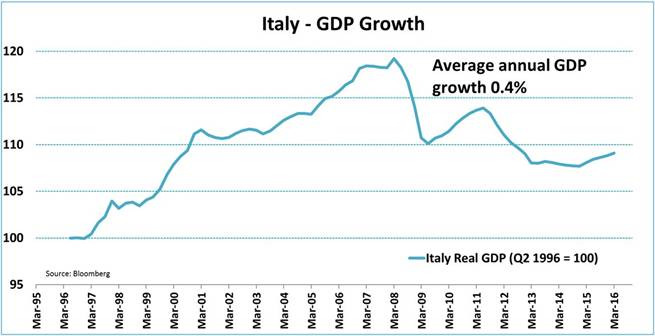
La banca italiana refleja el problema de Italia y su frenazo económico:
Con más detalle:
Se estancó y se llenó de deudas:
Y es la tercera economía europea… Abrazos,
PD1: Y para preparar a los inversores de una necesaria concentración para que se produzca el necesario saneamiento de varias entidades, a fusionarlos tocan…
The eurozone has too many banks, Mario Draghi has said, blaming overcapacity rather than the European Central Bank's monetary policy for low profits among commercial lenders.
Speaking at a conference of the European Systemic Risk Board on Thursday, Mr Draghi took on critics from the banking sector, who have blamed the ECB's negative interest rate policy for squeezing their margins, reports Claire Jones in Frankfurt.
The ECB president pointed to a report saying the banking sector had "outgrown capital markets" and said the high number of banks was a big factor on the low levels of profitability in the sector.
The ECB's deposit rate is currently at minus 0.4 per cent, meaning the central bank imposes a levy of the same amount on a portion of reserves parked by lenders at the central bank.
Overcapacity in certain banking sectors also meant their costs were too high, as an environment of too many lenders makes it difficult for banks to pass on costs to their customers, added Mr Draghi.
The problem with over reliance on banks was that their lending patterns tended to exacerbate the financial system's tendency towards boom and bust. On the other hand, capital markets "were a useful spare tyre", said the Italian.
The eurozone's capital markets, in which firms can issue bonds and equities, are much smaller than those in the US — which the ECB believes impedes the effectiveness of its quantitative easing policy of corporate and government bond buying.
Mr Draghi's comments come after the ECB revealed that its latest policy measure to boost bank lending by providing cheap loans (TLTRO-II) had attracted a take up of €45bn in its latest round.
Es una simpleza, pero funciona. ¿Te acuerdas cuando en España hicimos lo mismo con las cajas de ahorros? Las fusionamos para quebrarlas después… Es cojonudo lo listos que son estos tipos…
PD2: En España el dinero huye de los depósitos y se refugia en cuenta corriente…
Todos los españoles tienen en cuentas corrientes 479.000 millones de euros, y en depósitos bancarios: 289.000 millones de euros, mientras que debe España la friolera de 1.095.000 millones de euros, que no tenemos, ni podremos pagar en el futuro.
Además, los bancos españoles les deben a los bancos alemanes la abultada cifra de 300.000 millones de euros… Tú me dirás.
Y la mora:
PD3: Estuve en mi curso anual hace unos días. Es intenso y agotador, de seis días de duración. Se empieza con una meditación seguida de Misa. Luego dos clases de catecismo, tenemos clase de teología (este año nos ha tocado Soteriología y la Creación), por la mañana y por la tarde, charla, hemos visto la carta del Papa sobre el Año de la Misericordia, oración, Rosario, examen, y mucha convivencia con otros 25 asistentes, que nos contamos nuestras cosas, nuestras aficiones, nuestra familias… No ha faltado tampoco alguna cerveza en el bar del pueblo y paseos. Es la mejor forma de actualizar nuestra fe, de adquirir nuevos conocimientos, de estar al día, de formarse, de aprender, de convivir con gente parecida. Cada vez que vuelvo pienso que ha sido la mejor de cuantas he hecho. Es un gran esfuerzo, pero es reconfortante.

22 septiembre 2016

sin Gobierno

Hay dudas sobre si estamos mejor con o sin Gobierno. No lo dudes, estaríamos mucho mejor con un gobernante que supiera inglés y se dedicara a viajar por ahí fuera vendiendo la marca España…, yendo con empresarios españoles para establecer acuerdos con otras empresas para que invirtieran en España, haciendo que España sea más apetecida…

¿Podemos vivir sin gobierno?

Esta es una pregunta que nos viene preocupando a los españoles desde hace tiempo:¿podemos vivir sin gobierno? Sí, claro: llevamos ya más de ocho meses, y no nos ha ido mal. Parece que las consecuencias son insignificantes: el producto interior bruto sigue creciendo, se crea empleo, nos vamos de vacaciones y volvemos, seguimos consumiendo… Como decía la canción, la vida sigue igual 
De acuerdo. Pero hay cosas que nos preocupan, a pesar de todo. En el corto plazo, la incertidumbre. Siempre la hay, pero en nuestro caso tiene que ver con el color del gobierno, o sea, cuál será su sesgo político. Y esto tiene importancia, primero paralas inversiones privadas, y segundo para las estrategias de las empresas.
En el corto plazo, algunas decisiones del sector público estatal se ven afectadas. No cuando se trata de temas especializados (sospecho que los inspectores de Hacienda siguen trabajando febrilmente), o locales, o regionales, o de rutina, pero sí cuando afectan a decisiones más importantes. Desde que se convocaron las elecciones, las decisiones de infraestructuras y contratos públicos se han resentido. Esto tiene que ver con las caracterìsticas de nuestra administración pública: a niveles altos, el peso político es muy importante, a diferencias de otros países en los que los de primer nivel por debajo del Ministro ya son funcionarios de carrera (aquí también lo son, pero están ahí por encargo político).
Está luego el problema de la ejemplaridad; no que nuestros políticos se hayan caracterizado por sus comportamientos siempre ejemplares, pero ahora están dando una impresión muy pobre (a la que contribuyen también los medios de comunicación). El peligro de esta falta de ejemplaridad es que se acentúe la desconexión de los ciudadanos con sus gobernantes, lo que nos puede llevar a más populismo, más ambiente de contestación, más quejas… Y, a la larga, a un deterioro de la democracia (ya bastante herida) y las instituciones (gobierno, parlamento, jueces…).
Me parece que la economía española puede seguir funcionando durante bastante tiempo, a pesar de todo esto, si continúan las exportaciones y el turismo, el petróleo barato, los tipos de interés bajos, la abundancia de liquidez, etc. Pero, ya lo hemos comentado otras veces, nuestro modelo productivo dista mucho de ser el más adecuado.Esto significa que nuestro crecimiento potencial es limitado, y no bastará para resolver los grandes problemas: la creación de empleo, la productividad y los salarios, el déficit público, la innovación… Sí, necesitamos un gobierno. Pero no uno cualquiera, sino uno que entienda cuáles son nuestros problemas, y se proponga arreglarlos.
Abrazos,
PD1: En los últimos años lo que hemos realizado es una política de ajuste devaluatorio interno, siendo los sueldos y salarios los más resentidos. Al estar en el euro, no había mucho margen de maniobra y el mercado metió tijera en el empleo, y se ajustaron los sueldos y la precariedad laboral… Se han colocado muchos camareros, pero no son trabajos estables…
Y desde el punto financiero, no se atrevieron a coger el toro por los cuernos, y se dejó que las deudas subieran y subieran, se incumplió sistemáticamente con la diferencia entre ingresos públicos y gastos públicos y dejamos a España hecha un erial, que nuestros descendientes nos echarán en cara en los próximos decenios…
No hay mucho donde tocar en los gastos, salvo frenarlos y que no sigan creciendo… Pero no han podido y han preferido buscar más ingresos, que se comen nuestra capacidad de ahorro y de consumo…
Y no somos capaces de ajustar nuestro mercado laboral al de nuestros socios.
Tasa de paro:
PD2: El resultado lo podemos ver en los mercados: Rendimientos desde enero 2008 (US $):
US: +76%
Germany: -8%
UK: -9%
France: -17%
Spain: -34%
Italy: -55%
PD3: A los soberbios les cuesta más encontrar a Dios, mientras que los humildes lo hayan más fácilmente. Sencillez, no creerse mejor que los otros, así es como se consigue… Y mucha constancia, mucho insistir. Puede que hagamos oración y no oigamos nada…; insiste otro día, y otro día. Hay que buscarle, o dejar que nos encuentre.

21 septiembre 2016

pavor bancario

Los tipos negativos no les sienta nada bien a la banca europea, y en particular, a la italiana y la española…

They really don’t know what they are doing: QE and Spanish banks

I wrote on how negative rates are destroying the Italian banking system (here). Now, there is a new piece by Exane (here, via valueandopportunity) on how negative rates might play out in Spain. Unsurprisingly, the effects are similar.
Just as in Italy, Spanish banks have heavily invested in government bonds in order to benefit from the free central bank put provided by QE and whatever it takes. Just as in Italy, private sector lending has been crowded out (it probably was too high to begin with) and, just as in Italy, the low hanging fruit has been picked, now that Spanish government bonds yield less than the 10 year US treasury.
The report is entertaining to read, but the most interesting information can be found in this table,
It shows what percentage of the respective bank’s profit before tax (PBT) comes from interest payments and capital gains in the sovereign portfolio. The percentage is lowest for Santander (SAN) and BBVA, as they have substantial operations abroad and had not engaged in foolish real estate lending to begin with. Nevertheless, their dependence on income from their sovereign bond portfolio is substantial. For others, the importance of the sovereign book is way higher. For the seven largest Spanish banks, on average, 93 (!!!) percent of pre-tax net income comes from gains and income on their sovereign books.
The report mentions that the average remaining duration of the sovereign book is between 3-4 years, which means that over the next half decade virtually all of the Pre-tax profit in the Spanish banking system will disappear, if interest rates remain where they are.
Macro economists, as employed by central banks, no doubt would answer that this is exactly the purpose: force banks to lend more and help the economy grow out of the high debt (circular reasoning being a requirement for a PhD in this field).
They forget that in order to lend more to the private sector a bank a.) needs equity and b.) needs to find enough suitable costumers.
As for the equity, most of the equity in Spanish banks consists of tax loss carryforwards, i.e. it is not really there and not available to cover losses – and everybody knows that. Everybody who is not a macro economist, that is.
As for the costumers, Spanish banks are losing their best and biggest clients to – you guessed it – the ECB and to the bond market. Ask yourself: why should big Spanish corporates (Inditex, Endesa etc.) pay the overhead costs for such unnecessary things as underwriting departments and bank branches, if they can pay near zero in ETF and central bank dominated bond markets?
Answer: they don’t.
Thus Spanish banks are trying to find costumers by tricking Spaniards into credit card debt with opaque zero cost offers. If the only way you hope to grow your loan book profitably, is to screw your costumers, I would say that this is neither the way to grow your economy, nor sustainable.
There is no conspiracy – central banks really do not know what they are doing.
Hoy habrá rebote inicialmente al calor de más QE por el Banco de Japón… Más estímulos que es lo que mola. Pero son pan para hoy y mucha hambre mañana. Abrazos,
PD1: No dejes de ver el estudio de Exane BNP Paribas sobre la banca española. Muy interesante que refleja la realidad bancaria de ahora…
PD2: Banco Popular anuncia recorte 2900 empleos y cierre 300 oficinas. Desde ampliación en mayo sus acciones pierden -50%. Mala cosa para el sector que sabe que cuando acuden a una ampliación es para perder dinero…:
Deutsche Bank suma y sigue, otra galleta del -3.8% ayer:
Verificado: pánico a que la exposición de derivados, que parece no están bien valorados, ni están cubiertos con suficiente capital…
Otro caso: los bancos italianos: llenos de mora y miasmas:
Es mucho miedo lo que hay por ahí…, esa sensación de quiebras bancarias sostenidas por las autoridades para que no cunda el pánico… ¿Hasta cuándo? Quizás aguanten unos meses más, pero el desenlace de varias entidades está en manos de los políticos…, ya que los inversores han tirado la toalla.
PD3: Interesante lo que cuenta Enrique García Máiquez sobre los largos sermones de los curas:
En la misa Ad Orientem (donde el sacerdote celebra mirando atrás), como espaldas y cogotes son bastante impersonales, el protagonismo era todo del sacramento; pero ahora, como las caras suelen ser tan singulares, surge, según el poeta, un excesivo protagonismo de la individualidad del sacerdote y la consiguiente tendencia a personalizar las homilías e, incluso, la liturgia. El colombiano Gómez Dávila ya había sentenciado con su puntería característica: "Los ritos preservan, los sermones minan la fe".
No debe de ser casualidad que el enfriamiento de la fe popular haya coincidido con las reformas litúrgicas y las homilías divagatorias. Todavía he visto yo en la Sierra de Cádiz los últimos coletazos de la sana costumbre de que los hombres aprovechasen la homilía para salir a echar un cigarro. Desde que dejaron de salirse, dejaron de entrar. Sería más considerado anunciar, cuando el sacerdote desee exceder el límite de un breve comentario a la palabra de Dios, una conferencia suya a otra hora distinta, y a ver quién iba. Soltárnosla a los que fuimos a misa es abusar de nuestra devoción