15 enero 2018

ahorrar como meta en 2018

Póntelo como meta. Da igual los años que tengas. Si eres muy mayor, usa el ahorro para dárselo al que más lo necesita. Y si eres muy joven, tienes toda la vida por delante para que seas tu mismo el que lo vayas a necesitar… Párate un rato y reflexiona sobre la bondad de ahorrar…
Ahorrar podría ser un propósito maravilloso de enero. Ahorrar permite anticiparte a dificultades que no siempre se pueden controlar. También ayuda a mantener una economía sostenible. Gastamos muchísimo más de lo que necesitamos. Esta cultura de comprar como símbolo de felicidad nos lleva a derrochar en pequeñas tonterías que a lo largo de nuestras vidas suman un montante importante.
Cuando empecé a ser autónoma, es decir, desde mis inicios, me dio mucho miedo ponerme enferma y no tener una baja. Así que llevo más de veinte años pagando un seguro que cubre esta contingencia en caso de baja por enfermedad. En 23 años como profesional no he cogido ni una sola baja. Pero nunca sabemos las vueltas que puede dar la vida. Me gusta ser precavida. Me gusta sentirme segura, apoyada y no depender de nadie. Así que, además de mi pago de autónomos, pago este seguro, mi seguro de responsabilidad civil y un plan de pensiones. Y me supone un esfuerzo, pero la seguridad me da control y serenidad.
Ahorrar es una conducta responsable. Es cierto que a muchas personas, entre sus salarios precarios, la hipoteca y las demandas del día a día, ahorrar les supone una tarea imposible. Ahorrar tampoco es una conducta que forme parte de nuestra cultura. La cultura de tener vivienda en propiedad te lleva a pensar que ya tienes el ahorro de tu vida. Pero durante el día a día pueden surgir imprevistos, pequeños y grandes, que a veces obligan a pedir un préstamo o a no poder implicarte en temas que pueden ser importantes.
¿Por qué nos cuesta tanto ahorrar?
1.-La incapacidad económica. Hay gente a la que de verdad no les llega con sus ingresos, sin más.
2.-El atractivo del placer inmediato. Ahorrar es una conducta a largo plazo. Y ya sabemos que la dopamina, el neurotransmisor de la recompensa, desea ser siempre satisfecha de inmediato. Ahora, ya, como si no hubiera un mañana. Es tan grande el deseo que nos genera la dopamina, que dejamos de atender hábitos de vida saludables y también aquellos que tienen que ver con nuestra seguridad, como ahorrar.
3.-La ausencia de peligro. La juventud no teme al futuro. Y es normal, para ellos está demasiado lejos. Nadie cree que pueda enfermar mañana y que por ello necesite una asistencia urgente, que pueda tener que dejar de trabajar, que necesite un apoyo en casa, que pueda tener un familiar dependiente, etcétera, etcétera.
4.-La falta de responsabilidad. “Alguien se ocupará de mí”. Muchas son las personas que cuentan con el apoyo económico de padres y familiares, que a las malas, estarían para echar un cable.
Hace años leí un libro que me impactó: Coaching para el éxito, de Talane Miedaner. Os lo recomiendo muchísimo. Me llamó la atención, desde la visión americana, la importancia que tiene para ellos la idea de ahorrar. También me impresionó lo endeudados que estaban muchos de ellos con el gasto incontrolado de sus tarjetas. De todos los casos de que hablaba el libro, casi la totalidad habían llegado a tener serios problemas financieros en sus vidas por culpa del gasto descontrolado.
Para no vernos en una situación similar, os aconsejo una serie de medidas que pueden ayudaros a potenciar la conducta de ahorrar.
1.No cuentes con lo que no es tuyo. ¿Qué significa? Las personas cobran una nómina o sus facturas. En ese dinero, a pesar de haberlo ganado tú, hay una gran parte que no es tuya: la hipoteca, los seguros, el material escolar, el recibo del seguro médico, etc. Cuanto antes apartes ese dinero, menos probabilidad tendrás de gastar lo que luego te hará falta. Puedes abrir una segunda cuenta en la que inmediatamente ingreses todo aquello que es un gasto fijo, como el IVA de tus facturas. No es tuyo. Si lo dejas en tu cuenta, tendrás la ilusión óptica de pensar que tienes más de lo que es, y cuando llegue el pago del trimestre te costará más afrontarlo.
2.¿Podrías renunciar a algo? Si eres de los que con sus ingresos sinceramente no puede apartar nada, ¿podrías renunciar a algo? ¿Tabaco, salir a correr por el parque en lugar de pagar un gimnasio, comprar en el mercado de abastos una vez a la semana en lugar de comprar comida procesada en el supermercado, que es mucho más cara y menos saludable…? Piénsalo bien. Dale un giro a la situación; siempre hay algo a lo que podemos renunciar, sin tener que renunciar a nuestras aficiones o calidad de vida.
3.Aparta algo cada mes. Ten una cuenta paralela de ahorro o una hucha en casa en la que puedas meter parte de lo que ingresas. Trata de que esa cuenta o esa hucha sean intocables. Siempre surgen imprevistos. Una pequeña intervención, la ortodoncia de los niños, un regalo de boda, etc. Talane Miedaner proponía ahorrar el diez por ciento de lo que ingresas.
4.Piensa en el futuro. Ahora no lo ves, pero el futuro está mucho más cerca de lo que imaginas. ¿No te has dado cuenta de lo rápido que ha pasado 2017? Busca un plan de pensiones basado en tus necesidades y aporta un mínimo. Solo se trata de adquirir el hábito de apartar algo. Poco a poco, juntarás un pequeño ahorro que te animará a seguir haciéndolo.
5.No te entrampes con bodas, vacaciones, comuniones, etc. Aprendamos a vivir con menos y a la altura de nuestros ingresos. Sinceramente, la felicidad no está en invitar a la comunión de la niña a cuatrocientas personas, ni en regalarle la tablet. Si crees que esto es la felicidad, igual habría que empezar a revisar la escala de valores.
6.Paga tus deudas. Como dice Talane en su libro, las deudas nos llevan a estar más endeudados. Buscas pagar con una tarjeta la liquidez que ya no te queda en la otra. Hay profesionales que pueden ayudarte con esto. Trata de refinanciar y agrupar tus deudas y, durante un tiempo, vivir de tal manera que te permita sanear tu economía.
7.Crea una reserva de dinero. Ahorrar durante unos años y tener una reserva que te permita dejar de trabajar unos meses sería una motivación genial y una tranquilidad absoluta. Mucha gente vive agobiada pensando que un día puede perder su trabajo o que le encantaría poder formarse y aspirar a otra cosa, pero no se lo puede permitir. Trata de apartar un porcentaje de tu salario durante un tiempo hasta que tengas una reserva de unos seis meses para poder vivir sin trabajar.
Todo son ideas, espero que alguna sea viable en tu sistema. Te animo a probarlo durante este 2018 y a sentir la tranquilidad de tener dinero ahorrado.
Abrazos,
PD1: Te pongo un ejemplo muy burdo de la bondad del ahorro.
Una persona que no se había planteado la jubilación y su ahorro. Tiene 52 años cuando empieza. Y es capaz de ahorrar 1000 euros al mes los primeros 14 años, desde los 52 años hasta los 65 años que se jubila. Luego cobrará 2000 euros/mes durante 20 años con el fruto de sus ahorros privados… Nada tiene que ver la Seguridad Social ni la pensión pública… Pero hay que empezar en un momento determinado…
CUANTO PODRÉ GENERAR PARA MI JUBILACION
rentabilidad:
7


APORTACION


MES
AÑO
INICIO
FINAL
52
año 1
2018
1.000
12.000
0
12.000
53
año 2
2019
1.000
12.000
12.000
24.840
54
año 3
2020
1.000
12.000
24.840
38.579
55
año 4
2021
1.000
12.000
38.579
53.279
56
año 5
2022
1.000
12.000
53.279
69.009
57
año 6
2023
1.000
12.000
69.009
85.839
58
año 7
2024
1.000
12.000
85.839
103.848
59
año 8
2025
1.000
12.000
103.848
123.118
60
año 9
2026
1.000
12.000
123.118
143.736
61
año 10
2027
1.000
12.000
143.736
165.797
62
año 11
2028
1.000
12.000
165.797
189.403
63
año 12
2029
1.000
12.000
189.403
214.661
64
año 13
2030
1.000
12.000
214.661
241.688
65
año 14
2031
1.000
12.000
241.688
270.606
66
año 15
2032
-2.000
-24.000
270.606
265.548
67
año 16
2033
-2.000
-24.000
265.548
260.137
68
año 17
2034
-2.000
-24.000
260.137
254.346
69
año 18
2035
-2.000
-24.000
254.346
248.150
70
año 19
2036
-2.000
-24.000
248.150
241.521
71
año 20
2037
-2.000
-24.000
241.521
234.427
72
año 21
2038
-2.000
-24.000
234.427
226.837
73
año 22
2039
-2.000
-24.000
226.837
218.716
74
año 23
2040
-2.000
-24.000
218.716
210.026
75
año 24
2041
-2.000
-24.000
210.026
200.728
76
año 25
2042
-2.000
-24.000
200.728
190.779
77
año 26
2043
-2.000
-24.000
190.779
180.133
78
año 27
2044
-2.000
-24.000
180.133
168.743
79
año 28
2045
-2.000
-24.000
168.743
156.555
80
año 29
2046
-2.000
-24.000
156.555
143.514
81
año 30
2047
-2.000
-24.000
143.514
129.560
82
año 31
2048
-2.000
-24.000
129.560
114.629
83
año 32
2049
-2.000
-24.000
114.629
98.653
84
año 33
2050
-2.000
-24.000
98.653
81.558
85
año 34
2051
-2.000
-24.000
81.558
63.267
86
año 35
2052
-2.000
-24.000
63.267
43.696
87
año 36
2053
-2.000
-24.000
43.696
22.755
88
año 37
2054
-2.000
-24.000
22.755
348
PD2: Además ya sabemos que el sistema público está quebrado, que los políticos no quieren meterle mano, que no se van a apreciar las pensiones más, que cuando nos jubilemos dependemos de un impuesto para pagar las pensiones, como ya ahora, y de que vengas inmigrantes que coticen…, como ahora… Estos son los datos:
PD3: Durante nuestro tiempo diario de oración deseamos y pedimos oír la voz del Señor. Pero, quizás con demasiada frecuencia, nos preocupamos de llenar ese tiempo con palabras que nosotros queremos decirle, y no dejamos tiempo para escuchar lo que nos quiere comunicar. Hay que tener mucho cuidado de estar calladitos, del silencio interior, que, evitando las distracciones y centrando nuestra atención, nos abre un espacio para acoger los afectos, inspiraciones... que el Señor nos manda a nuestros corazones.

12 enero 2018

las 10 reglas de la inversión

Son como los 10 Mandamientos, siempre hay que volver a ellos para entender de qué va esto…

Bob Farrell’s Illustrated 10-Investment Rules

Over the weekend, it was interesting to see the number of advisors/analysts quickly rushing to defend their “buy and hold” investing philosophies following the sharp decline on Friday. As I wrote this past weekend:
“The downfall of all investors is ultimately ‘greed’ and ‘fear.’ 
They don’t sell when markets are near peaks, nor do they buy market bottoms. However, this does not just apply to individuals but many advisors as well.
When I read articles from advisors/managers promoting ‘buy and forget’ strategies it is for one of three reasons. They either can’t, don’t want to, or don’t know how to manage portfolio risk. Therefore, the easy message is simply:
‘You just have to ride the market out. Long-term it will go up. But hey, let me charge you a fee for holding your stuff in an account.’ 
The reality is that markets do not return 6%, 8% or 10% annually, and spending years making up previous losses is not a way to successfully obtain retirement goals. (Read this)
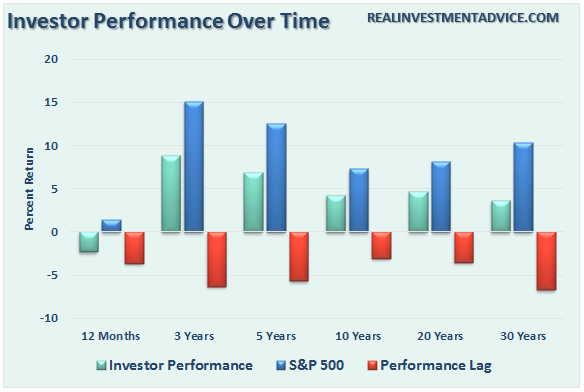
It is also worth pointing out that those promoting these ‘couch potato’ methodologies are generally out in full force near peaks of bull market cycles, and are rarely heard of near bear market bottoms. This is why, as I discussed in ‘Why You Still Suck At Investing,’ investors consistently underperform over long periods of time.” 
When markets are at, or near, “record levels” those levels are records for a reason. Throughout history awe-inspiring bull markets have been followed by devastating bear markets. Like “yen and yang,” a bull cannot exist without its forever intertwined counterpart.
Despite the media, advisor and analysts rhetoric to the contrary, investors DO have the ability to manage the inherent risk in their portfolios.
Investors can capture returns and grow their “savings” versus just blindly hoping that history will not once again repeat itself. While I can’t tell you exactly when the second half of the full-market cycle will manifest itself, I can assure you it will and the negative impact to retirement goals, and the time lost, will be just as damaging.
One other question to ponder. While Wall Street tells you to “just hold on and ride the market out,” why are they managing risk, spending billions on trading platforms and algorithms, and in many instances betting against you? 
With this in mind, I present Bob Farrell’s 10-Investment Rules. While these rules should be a staple for any investor who has put their hard earned “savings” at risk in the market, they are rarely heeded in the heat of bull market. Just as they are being ignored now.

Who is Bob Farrell?

Bob is a Wall Street veteran with over 50 years of experience in crafting his investing rules. Farrell obtained his master’s degree from Columbia Business School and started as a technical analyst at Merrill Lynch in 1957. Even though Farrell studied fundamental analysis under Gramm and Dodd, he turned to technical analysis after realizing there was more to stock prices than balance sheets and income statements. Farrell became a pioneer in sentiment studies and market psychology. His 10 rules on investing stem from personal experience with dull markets, bull markets, bear markets, crashes, and bubbles. In short, Farrell has seen it all and lived to tell about it.

The Illustrated 10-Rules Of Investing

1.- Markets tend to return to the mean (average price) over time.

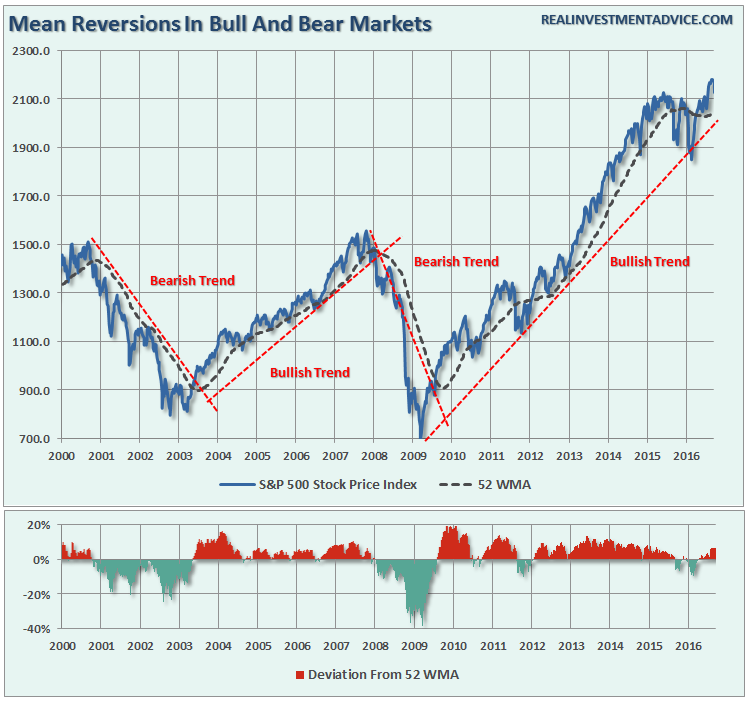
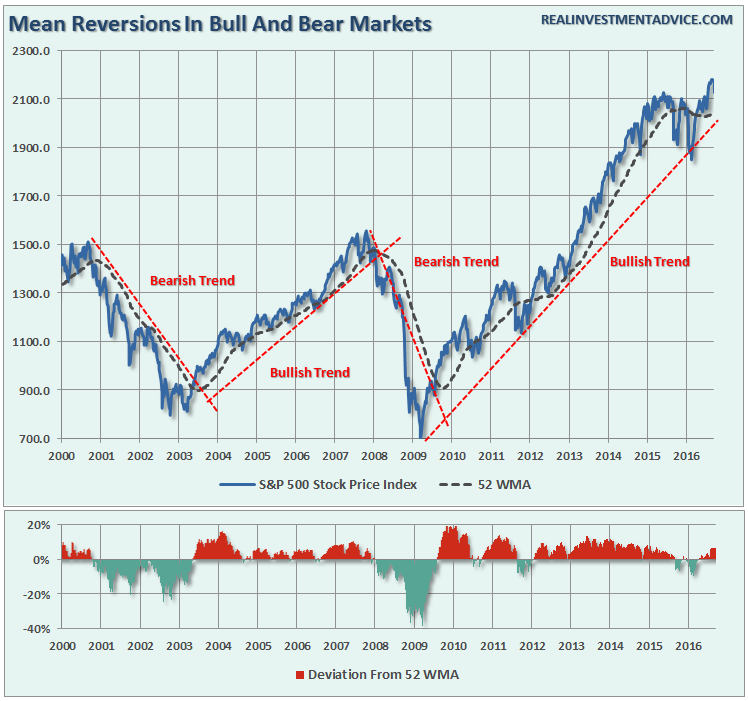
Like a rubber band that has been stretched too far – it must be relaxed in order to be stretched again. This is exactly the same for stock prices which are anchored to their moving averages.  Trends that get overextended in one direction, or another, always return to their long-term average. Even during a strong uptrend or strong downtrend, prices often move back (revert) to a long-term moving average. The chart below shows the S&P 500 with a 52-week simple moving average.
The bottom chart shows the percentage deviation of the current price of the market from the 52-week moving average. During bullish trending markets, there are regular reversions to the mean which create buying opportunities. However, what is often not stated is that in order to take advantage of such buying opportunities profits should have been taken out of portfolios as deviations from the mean reached historical extremes. Conversely, in bearish trending markets, such reversions from extreme deviations should be used to sell stocks, raise cash and reduce portfolio risk rather than “panic sell” at market bottoms.
The dashed RED lines denote when the markets changed trends from positive to negative. This is the very essence of portfolio “risk” management.

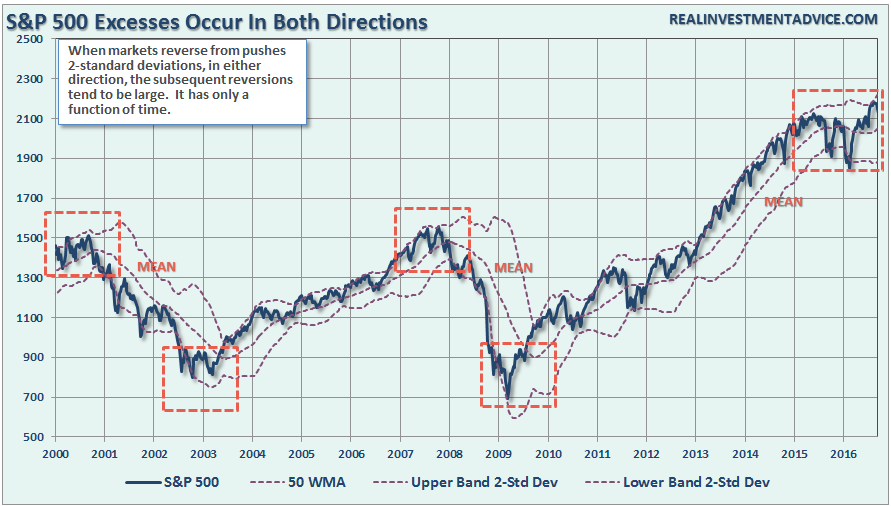
2.- Excesses in one direction will lead to an opposite excess in the other direction.

Markets that overshoot on the upside will also overshoot on the downside, kind of like a pendulum. The further it swings to one side, the further it rebounds to the other side. This is the extension of Rule #1 as it applies to longer term market cycles (cyclical markets).
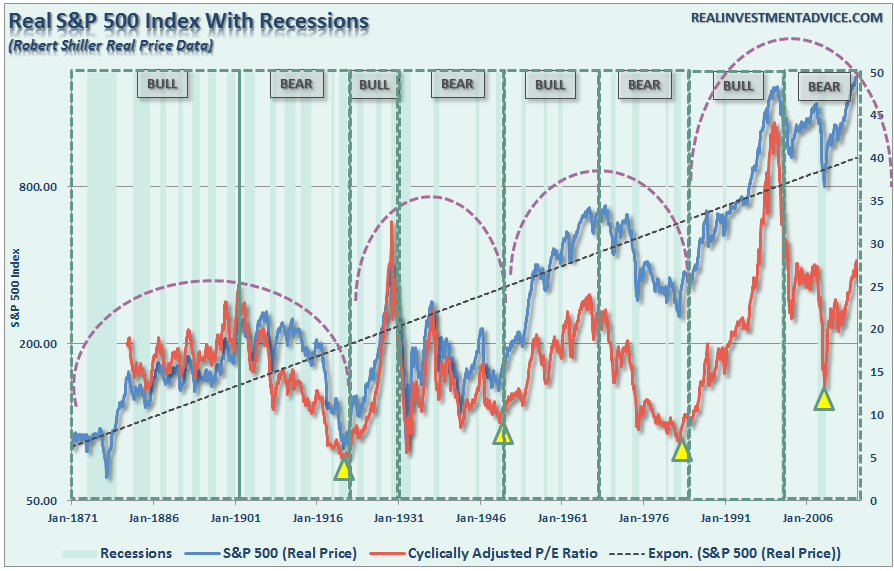
While the chart above showed prices behave on a short term basis – on a longer term basis markets also respond to Newton’s 3rd law of motion: “For every action, there is an equal and opposite reaction.” The first chart shows that cyclical markets reach extremes when they are more than 2-standard deviations above or below the 50-week moving average. Notice that these excesses ARE NEVER worked off by just going sideways.
The second chart shows the price reversions of the S&P 500 on a long term basis and adjusted for inflation. Notice that when prices have historically reached extremes – the reversion in price is just as extreme. It is clear that the current reversion in the stock market is still underway from the 2000 peak.

3.- There are no new eras – excesses are never permanent.

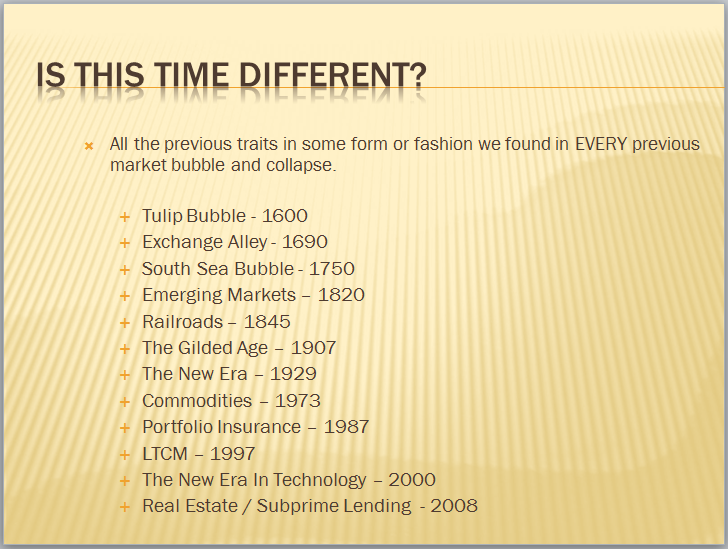
There will always be some “new thing” that elicits speculative interest.  These “new things” throughout history, like the “Siren’s Song,” has led many investors to their demise. In fact, over the last 500 years, we have seen speculative bubbles involving everything from Tulip Bulbs to Railways, Real Estate to Technology, Emerging Markets (5 times) to Automobiles and Commodities. It always starts the same and ends with the utterings of “This time it is different”
[The chart below is from my March 2008 seminar discussing that the next recessionary bear market was about to occur.]
As legendary investor Jesse Livermore once stated:
“A lesson I learned early is that there is nothing new on Wall Street. There can’t be because speculation is as old as the hills. Whatever happens in the stock market today has happened before and will happen again.”

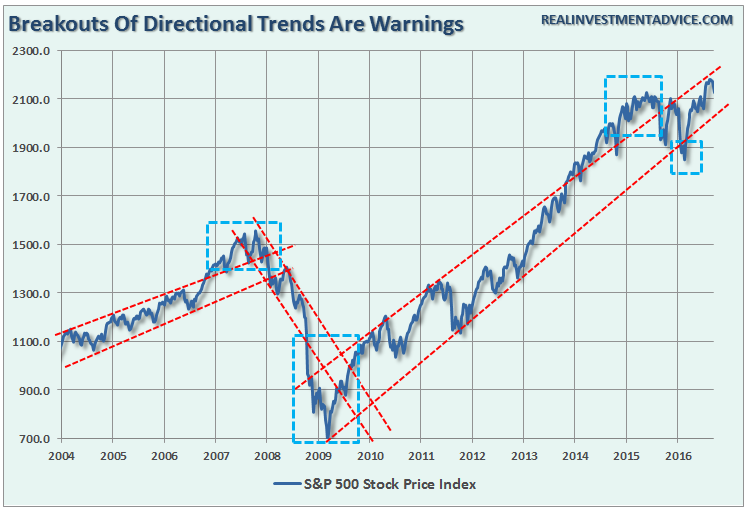
4.- Exponential rapidly rising or falling markets usually go further than you think, but they do not correct by going sideways

The reality is that excesses, such as we are seeing in the market now, can indeed go much further than logic would dictate. However, these excesses, as stated above, are never worked off simply by trading sideways. Corrections are always just as brutal as the advances were exhilarating. As the chart below shows when the markets broke out of their directional trends – the corrections came soon thereafter.

5.- The public buys the most at the top and the least at the bottom.

The average individual investor is most bullish at market tops and most bearish at market bottoms. This is due to investor’s emotional biases of “greed” when markets are rising and “fear” when markets are falling. Logic would dictate that the best time to invest is after a massive sell-off; unfortunately, this is exactly the opposite of what investors do.

6.- Fear and greed are stronger than long-term resolve.

As stated in Rule $5 it is emotions that cloud your decisions and affect your long-term plan.
“Gains make us exuberant; they enhance well-being and promote optimism,” says Santa Clara University finance professor Meir Statman.  His studies of investor behavior show that “Losses bring sadness, disgust, fear, regret. Fear increases the sense of risk and some react by shunning stocks.”
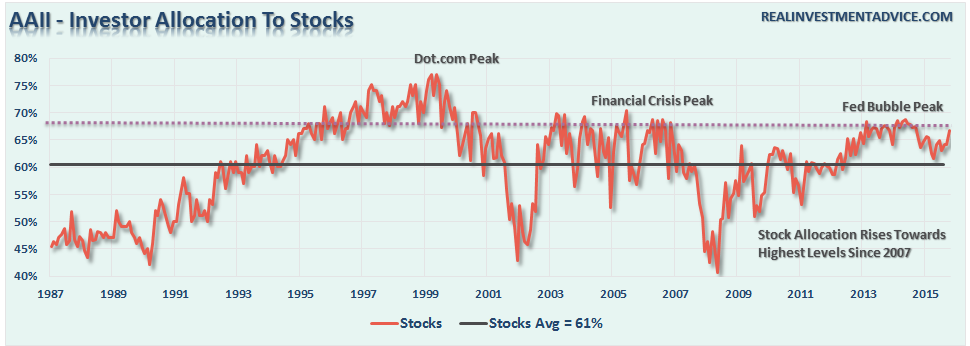
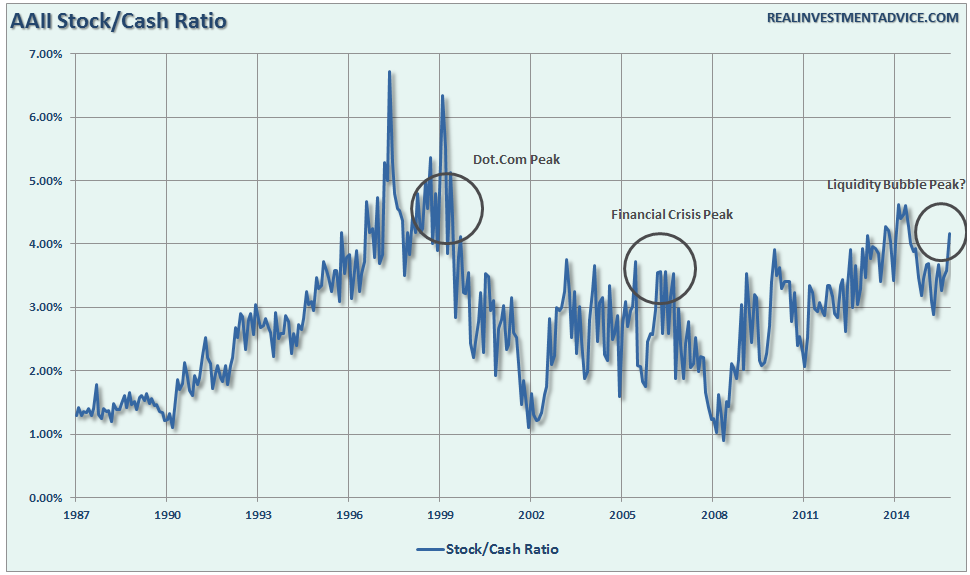
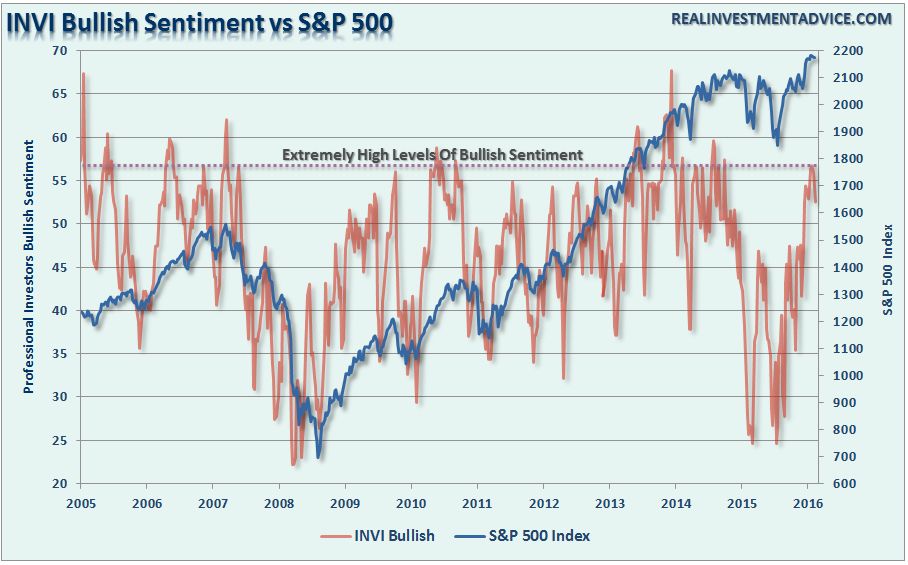
The index of bullish sentiment shows that “greed” is once again beginning to reach levels where markets have generally reached intermediate-term peaks.
In the words of Warren Buffett:
“Buy when people are fearful and sell when they are greedy.”
Currently, those “people” are getting extremely greedy.

7.- Markets are strongest when they are broad and weakest when they narrow to a handful of blue-chip names.

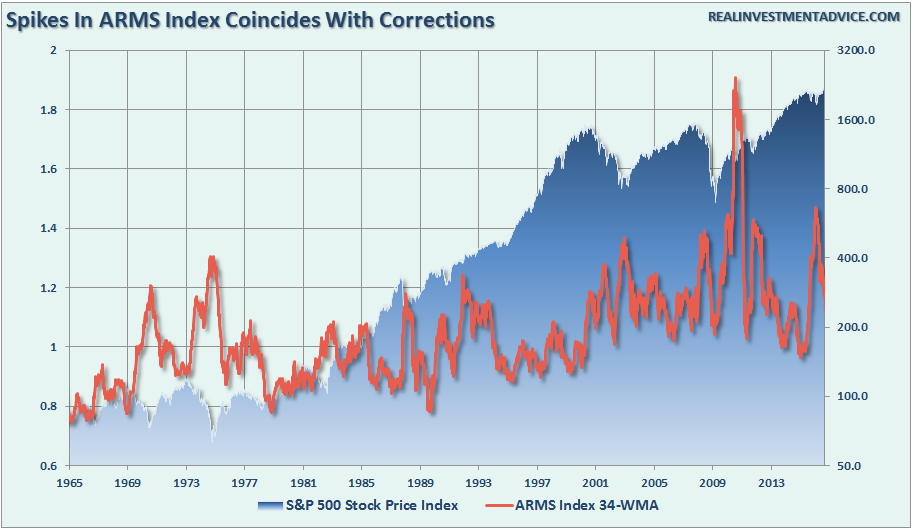
Breadth is important. A rally on narrow breadth indicates limited participation and the chances of failure are above average. The market cannot continue to rally with just a few large-caps (generals) leading the way. Small and mid-caps (troops) must also be on board to give the rally credibility. A rally that “lifts all boats” indicates far-reaching strength and increases the chances of further gains.
The chart above shows the ARMS Index which is a volume-based indicator that determines market strength and breadth by analyzing the relationship between advancing and declining issues and their respective volume.  It is normally used as a short term trading measure of market strength. However, for longer term periods the chart shows a weekly index smoothed with a 34-week average. Spikes in the index has generally coincided with near-term market peaks.

8.- Bear markets have three stages – sharp down, reflexive rebound and a drawn-out fundamental downtrend

Bear markets often start with a sharp and swift decline. After this decline, there is an oversold bounce that retraces a portion of that decline. The longer term decline then continues, at a slower and more grinding pace, as the fundamentals deteriorate. Dow Theory suggests that bear markets consist of three down legs with reflexive rebounds in between.
The chart above shows the stages of the last two primary cyclical bear markets. The point to be made is there were plenty of opportunities to sell into counter-trend rallies during the decline and reduce risk exposure. Unfortunately, the media/Wall Street was telling investors to just “hold on” until hey finally sold out at the bottom.

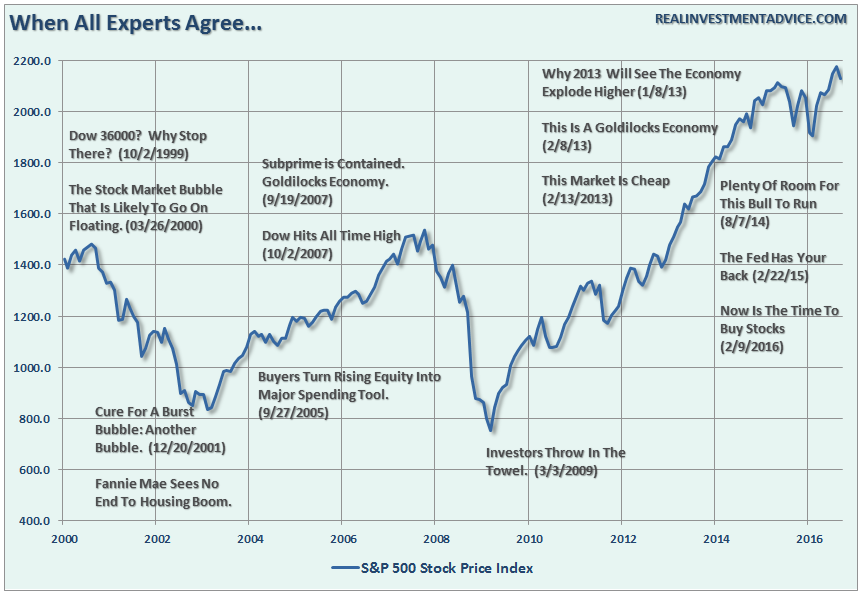
9.- When all the experts and forecasts agree – something else is going to happen.

This rule fits within Bob Farrell’s contrarian nature. As Sam Stovall, the investment strategist for Standard & Poor’s once stated:
“If everybody’s optimistic, who is left to buy? If everybody’s pessimistic, who’s left to sell?”
As a contrarian investor, and along with several of the points already made within Farrell’s rule set, excesses are built by everyone being on the same side of the trade. Ultimately, when the shift in sentiment occurs – the reversion is exacerbated by the stampede going in the opposite direction
Being a contrarian can be quite difficult at times as bullishness abounds. However, it is also the secret to limiting losses and achieving long-term investment success. As Howard Marks once stated:
“Resisting – and thereby achieving success as a contrarian – isn’t easy. Things combine to make it difficult; including natural herd tendencies and the pain imposed by being out of step, since momentum invariably makes pro-cyclical actions look correct for a while. (That’s why it’s essential to remember that ‘being too far ahead of your time is indistinguishable from being wrong.’)
Given the uncertain nature of the future, and thus the difficulty of being confident your position is the right one – especially as price moves against you – it’s challenging to be a lonely contrarian.”

10.- Bull markets are more fun than bear markets

As stated above in Rule #5 – investors are primarily driven by emotions. As the overall markets rise; up to 90% of any individual stock’s price movement is dictated by the overall direction of the market hence the saying “a rising tide lifts all boats.”
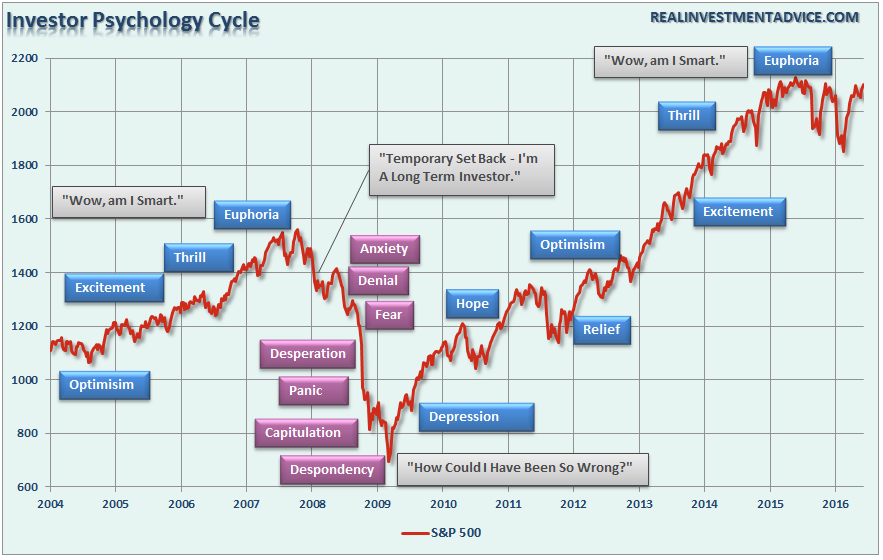
Psychologically, as the markets rise, investors begin to believe that they are “smart” because their portfolio is going up. In reality, it is primarily more a function of “luck” rather than “intelligence” that is driving their portfolio.
Investors behave much the same way as individuals who addicted to gambling. When they are winning they believe that their success is based on their skill. However, when they began to lose, they keep gambling thinking the next “hand” will be the one that gets them back on track. Eventually – they leave the table broke.
It is true that bull markets are more fun than bear markets. Bull markets elicit euphoria and feelings of psychological superiority. Bear markets bring fear, panic, and depression.
What is interesting is that no matter how many times we continually repeat these “cycles” – as emotional human beings we always “hope” that somehow this “time will be different.” Unfortunately, it never is and this time won’t be either. The only questions are: when will the next bear market begin and will you be prepared for it?

Conclusions

Like all rules on Wall Street, Bob Farrell’s rules are not meant has hard and fast rules. There are always exceptions to every rule and while history never repeats exactly it does often “rhyme” very closely.
Nevertheless, these rules will benefit investors by helping them to look beyond the emotions and the headlines. Being aware of sentiment can prevent selling near the bottom and buying near the top, which often goes against our instincts.
Regardless of how many times I discuss these issues, quote successful investors, or warn of the dangers – the response from both individuals and investment professionals is always the same.
 “I am a long term, fundamental value, investor.  So these rules don’t really apply to me.”
No, you’re not. Yes, they do.
Individuals are long term investors only as long as the markets are rising. Despite endless warnings, repeated suggestions and outright recommendations; getting investors to sell, take profits and manage your portfolio risks is nearly a lost cause as long as the markets are rising. Unfortunately, by the time the fear, desperation or panic stages are reached it is far too late to act and I will only be able to say that I warned you.
Espero te haya servido tanto como a mi… Un fuerte abrazo,
PD1: ''Hacer el bien sin cálculos, incluso cuando nadie nos lo pide, incluso cuando no ganamos nada con ello, incluso cuando no nos gusta. Dios quiere esto", Papa Francisco.

11 enero 2018

Diferentes momentos de Amazon contados por Bezos, su fundador y CEO

Muy interesante, sobretodo el primer video del año 1999, antes de la explosión de la burbuja tecnológica del 2000 y antes de que se convirtiera en la gran empresa de retail que todo lo vende… Mira lo que piensa Bezos de su negocio:
Así empezó Jeff Bezos en 1999:
Bezos en 2007:
La evolución de Amazon en los primeros años, cuando sucumbió en la burbuja, y se recuperó:
En 2013 ya arrasaba Amazon:
En 2017, cuando no tiene nada que ver con lo que era y todo quisqui compra de todo en Amazon, que lidera en todo y mata a toda su competencia:
Y la explosión reciente en bolsa, los últimos años, cuando descuenta no los beneficios que sigue sin conseguir, sino las expectativas de ganancias futuras: Se ha multiplicado por 4 veces en los últimos 5 años:
Ha hundido al sector retail en EEUU y se ha hecho con un nicho de mercado alucinante. Si no has visto el primer video de arriba, vuelve a él. Es espectacular saber cómo fueron los primeros años del fundador, y de su peculiar forma de ver las cosas y los negocios… Grandísima enhorabuena!!! La única pena, que no haya más gente que piense como él, con esa sencillez y ese carisma. Un gran tipo!!!
Y es resto de las tecnológicas de moda andan igual de en las nubes… ¿Hasta dónde está dispuesto el inversor medio a llevarse las cotizaciones de las empresas de moda? Es de locos…
GOOGLE:
APPLE:
NETFLIX:
AMAZON:
FACEBOOK:
BAIDU:
ALIBABA:
TENCENT:
Es una moda de locos… Sólo se fían de los valores de moda y se desprecia al resto que ven como pasa el mercado delante de ellos sin que suban… Es el ejemplo de la Inditex española, antes tan de moda, pero muy rezagada en los dos últimos años ya que salió del circuito extranjero… Ni te cuento otras españolas como Telefónica o los bancos grandes…
Y otras estadounidenses, que estuvieron de moda hace unos años, cayeron en desgracia…, se pasaron de moda… Es el caso de Go Pro entre otras:
Abrazos,
PD1: "Si no eres apasionado por lo que haces, no tienes una profesión, tienes un trabajo."
Ojalá seamos todos apasionados con lo que hacemos, con el trabajo profesional y con el doméstico cuando estamos en casa y toca ayudar y no escaquearse. Ojalá comprendamos que cada hora de trabajo/estudio bien realizada y ofrecida es una hora de oración…, por la que se pueden pedir muchas intenciones espirituales.

10 enero 2018

no hay valor en ningun sitio

Las expectativas de inflación sigue presionando todo. Ahora hasta el crudo vuelve a incordiar:
Esto no se va a repetir:
Debe venir una corrección:
Ha durado demasiado el mercado alcista:
Tocan rebajas…
Seimpre ha habido una alternancia entre mercados bajistas y alcistas… Llevamos muchos años con un mercado alcista que se truncará también… Sólo con que se vaya a su media será suficiente para que muchos pierdan parte de lo ganado recientemente… (reversión a la media)
Los mercados de acciones han sido liderados por dos factores que no se van a repetir: buybacks y margin credit. No se van a seguir comprando más acciones propias de las empresas cotizadas a estos niveles… Y el apalancamiento marginal para comprar más bolsa a crédito, es temeroso…
Y los mercados de bonos están muy caros. Se ha invertido en los últimos 10 años mucho en High Yield. Ahora, con estos spreads alcanzados, ¿quién es el guapo que se la juega con el High Yield?
No hay valor en los bonos, no hay nada que ganarle y sí mucho que perder…
Y la relación euro dólar lo complica todo:
Aunque empiezan a haber alternativas de inversión:
Las expectativas de rentabilidad para los próximos 5 años se quedan reducidas al signo NEGATIVO…quien tenga acciones del SP500 y las mantenga 5 años, perderá dinero…
Abrazos,
PD1: La verdad nos hace libres, y el dolor grandes. El dolor es la forja del alma; es un mal, pero repleto de cosas buenas. La ilusión de la autosuficiencia humana sólo puede quebrarse mediante el sufrimiento. El dolor es el último recurso de Dios para hacernos verdaderamente felices, es decir, buenos y sabios, y salvarnos. El dolor es el manotazo que nos permite recibir lo único que puede hacernos felices: la entrega total a Dios.