09 diciembre 2016

Trump Rally

Seguimos con el efecto Trump y su política de desregulación que se ha llevado a los mercados a las nubes…, (bueno, han subido los bancos y las energéticas) ¿Hasta cuándo?
Para que te hagas una idea, desde las elecciones, han subido los bancos y, sin embargo, las FANG no les han seguido:
JPMorgan: +20%
Goldman Sachs: +30%
Morgan Stanley: +25%
Citibank: +18%
Bank of America: +33%
...
Facebook: -5%
Amazon: -2%
Apple: 0%
Google: -3%
¿Ridículo? ¿Comprarías tú bancos o small caps estadounidenses por el hecho de la nueva desregulación? ¿Tienen que subir en Europa los bancos, al alimón de los bancos yanquis, cuando las rentabilidades negativas les ahogan y nos queda mucho hasta llegar al tapering, y con los problemas de cada país (mora, bail outs en Italia, Deutsche Bank)? Es de coña y demuestra lo manipulado que están los mercados por los propios bancos, que mueven, cuando pueden, sus cotizaciones donde quieren.
When I was on CNBC on Monday afternoon, the discussion was over this stellar stock market performance of the past month, otherwise known as the “Trump Rally.”
Let’s examine it a little closer, if you don’t mind.
No doubt there have been stellar performances among the two sectors that stand to benefit most from the “D” word (deregulation): financials and energy. These were the two sectors that were on the long list for a long time in the event of a Trump victory.
Both have lived up to their billing, having advanced 14.1%, and 7.0%, respectively, since the election. These two sectors, representing just over 20% of the S&P 500 market cap, have accounted for all the gains since then. The other 80% of the stock market is flat as a pancake.
Now, I have no problem with financials and energy, and there likely is more upside too. The former was one of the few sectors heading into the election that was undervalued and the banks will get an added boost as well from expanded net-interest margins; the OPEC deal, if it holds together, is an added plus for the energy group.
But the other sector that has been getting heady has been the industrials – soaring on high hopes of some big infrastructure package.
The deregulation file is something that Donald Trump can do on his own and there is also support in Congress – especially with regards to Dodd-Frank and the Volcker Rule – but there is little appetite actually for a boondoggle spending program.
Besides, there always is infrastructure spending going on – the highway spending bill passed two years ago and the remnants of the American Recovery and Reinvestment Act of 2009. It’s just that infrastructure is a nice motherhood issue and it gets investors excited – but frankly, the up-move in industrials premised on infrastructure looks really overdone to me. And when you look at the stock market excluding financials, energy and industrials, well guess what? It is actually down fractionally since Nov. 8.
Go figure.
It is not a stellar market at all. Just a stellar performance by a couple of sectors.
And this is not a Trump Rally, by the way. The market likely would have rallied on a win by Hillary Clinton, too. Practically every new president back to Truman seven decades ago enjoys what is otherwise known as a Honeymoon Rally – the median stock-market advance the month after an election is nearly 1%.
Okay, so the president-elect is now at 3%, again skewed by two or three sectors. Big deal. Ronald Reagan, who was the original “Make America Great Again” advocate (as opposed to a copycat), saw the equity market soar 6% in his first month in office.
Guess what? The market peaked less than four weeks into his term and for the next two years we had an economic downturn and a 25-per-cent slide in the stock market. The combination of rising bond yields, Fed tightening and a stronger dollar took care of that honeymoon.
After all, we all know what happens when the honeymoon is over. The hard work begins.
That slump we just saw in October export volumes and widening in the trade deficit is surely just an early sign of what is to come.
Before The Donald does anything on his first hundred days, something tells me the lagged impact of the tightening in financial conditions associated with the recent bounce in interest rates and appreciation of the U.S. dollar is going to come back and bite the economy in the tush, as was the case heading into 2016.
As for the Treasury market, I get it. We were massively overbought at the July lows in yield, and the reversal in what was a negative term premium and a pickup in real rates that has accompanied a more loose fiscal policy outlook makes sense.
But there are 30 basis points of the run-up in yields since the election that do not make sense, and that is the increase in inflation expectations. There is no link at all between fiscal policy and inflation – look at Japan as a classic example.
For all the talk of a U.S. unemployment rate of 4.6%, that statistic is missing the nearly 12 million people either working part-time but want a full-time job and those not officially in the labour force but would take a job if offered one.
These folks serve up competition for jobs from the sidelines and help explain why wage growth is still rather modest.
So, the broad unemployment rate that includes marginally attached workers and those employed part-time for economic reasons is still elevated at 9.3% and I don’t believe we get to full employment until we break well below 8%.
Meanwhile, the U.S. dollar is firming and that will cause import deflation and the Fed, let’s face it, is tightening monetary policy.
So with all that in mind, I see 2% on the 10-year U.S. Treasury note yield (the yield is now about 2.4%) before we ever see 3% again. My two cents.
Le queda un poco más de tirón, y se acabó… No sé si no merece la pena el que se lo haya perdido.
Y en Europa, Draghi reduce el QE de 80.000 a 60.000 millones al mes, y lo alarga hasta finales 2017. Es decir, imprimimos 540.000 millones + que van a la caldera. Abrazos,
PD1: Es bastante insano:

The Equation That Explains It All

If you were just woken from some form of suspended animation from let’s say 2010 (ancient economic history in today’s terms) then informed of the current state of global political affairs and upheavals, U.S. employment (95+million not,) global currency gyrations, interest rates at not only 0% but some -0%, threats of escalating wars, threats of major confrontational war, GDP of the major global economies not only contracting, but below statistical stagnant, governments, as well as central banks with balance sheets of debt calculated in $TRILLIONS, some in the 10’s of, all financed at near or below 0%, and the Fed. is only about a week away from raising rates into the teeth of what can only be called “uncertainty,” and much, much more. (There isn’t enough time, or digital ink to list them all.)
Nobody would be surprised if your first reaction based on your prior acumen (the ancient history of 7 years ago whether it be in stocks, business, or both.) Would to become immediately concerned that whatever portfolio, or wealth you may have had in the markets, may be worth far less today than when you were first put to sleep. And probably becoming ever smaller as you thought about what you might need to do next in order to preserve any that may be left.
That is, till someone explained to you the markets you went to sleep knowing of – are no longer – and the reality of the markets today you could never have dreamed up. Even if they let you sleep another decade or longer.
Today, the markets you once knew of are better described as the “markets.”
To clear up any confusion as to how, or why the “markets” can now be at “never before seen in the history of mankind highs” once again after the resounding “NO” vote in Italy, where the entire E.U. experiment is now seriously undermined, and falling apart in real-time (Bexit first, Italy will surely now vote next, etc., etc,) below is the calculation that explains it all.
For under the rules of: If A = B and B = C, then A = C, you now have the magical formula to understand with Einstein like surety today’s ‘markets.”
If you have any doubt to the soundness of this expression, consider the following:
If a financial crisis appears (A) The central banks will intervene (B)
If the central banks intervene (B) The “markets” go up (C)
Thus, we need more financial chaos (A) To make even more all time “market” highs (C)
That is what “the greatest expression of capital formation the world has ever seen” has devolved into.
I’ve now come to the conclusion that even the term “casino” may no long fit. For these “markets” are no longer working on anything based on statistical math or economic expressions. Or, anything else related to understandable business metrics such as: a company’s value is based on net profits or any such thing.
No, there’s only one word for it now as to explain just how beholden it is to adhering, and repeating the above calculus. And it just so has it, Einstein said it best: “Insanity.”
PD2: De nuevo, el Reto
La manera en que saludas a una persona dice mucho de cómo amas a esa persona. Cuando te levantas por la mañana, la manera de dar los buenos días en casa con la persona que te cruzas, la expresión, tu cara, la manera en que hablas… de ese saludo con amor puede girar todo tu día y del que tienes junto a ti. Cuando comunicamos a alguien la felicidad que nos causa el verle, en el otro crece la autoestima.
Jesús nos dice que tratemos con amor y misericordia a nuestros enemigos. Posiblemente hoy te encontrarás con alguien que no te agrada demasiado, pero seguro que, por educación, le saludarás. ¿Y la persona que amas? ¿No se merece que le trates igual o diez veces mejor?
Muchas veces, con los más cercanos tenemos un trato muy duro, de poco amor y misericordia. Recuerda la parábola del hijo pródigo: el padre le saludó con un abrazo. ¿Cómo crees que se sintió al recibir el abrazo de su padre y escuchar su voz llena de profunda alegría? Sin duda que se sintió amado y agradecido.
Hoy el reto del amor es saludar desde el amor con una simple palabra, un gesto de cariño o tu tono de voz. Hoy, en tus saludos, cuida que sean cálidos y con entusiasmo: el Señor te da la oportunidad de tocar el corazón del otro. Recuerda, el amor es una decisión. Así que decide cambiar tu forma de saludar. Elige amar…

07 diciembre 2016

invertir a largo plazo

Consideraciones interesantes:

Los seis mandamientos para tener éxito en la inversión a largo plazo

Invertir con éxito a largo plazo no resulta tan sencillo como parece. Es importante ser disciplinado y seguir una metodología de la que no todos los inversores hacen gala. J.P.Morgan Asset Management no sólo ha revelado las leyes fundamentales que todo inversor debería seguir a la hora de construir sus carteras, sino que también ha querido demostrar empíricamente el buen funcionamiento de esas normas. Si se siguen a raja tabla, las posibilidades de tener éxito se incrementan significativamente. Pero… ¿cuáles son esos seis mandamientos que todo inversor debe tener presente?
1. Invierta para el futuro. Vivimos cada vez más años. Gracias a los avances de la medicina y los hábitos de vida más saludables, la gente vive más. El siguiente gráfico muestra la probabilidad de que una persona que hoy tiene 65 años alcance los 80 o los 90. Una pareja de 65 años cada una podría sorprenderse al saber que existe un 66% de probabilidades de que al menos uno de ellos viva otros 25 años y llegue a los 90. Sin embargo, muchos no ahorran lo suficiente. Los estudios revelan que las personas no se sienten financieramente preparadas para la jubilación. Deberían tener un plan financiero para su futuro, empezando a invertir pronto, de manera frecuente y de una forma disciplinada.
2. El cash en raras ocasiones es el rey. A menudo los inversores piensan que la liquidez es el activo refugio en periodos de volatilidad, o incluso una fuente de retorno, pero la nueva era de tipos de interés ultra bajos ha conducido a la rentabilidad del cash a cerca del cero, lo que hace que la liquidez sea vulnerable a la erosión que provocaría a lo largo del tiempo la inflación. Con unos tipos de interés que se espera se mantengan bajos, los inversores deberían asegurarse de que su asignación a liquidez no socava sus objetivos de inversión a largo plazo. A largo plazo, el cash se comporta peor que el resto de activos. Los depósitos bancarios generan muy poco a largo plazo. Los inversores que aparquen su dinero en este tipo de productos se han perdido el impresionante rally de la renta variable y la renta fija.
3. El interés compuesto hace milagros. Comience a invertir cuanto antes y hágalo regularmente. Al interés compuesto se le conoce como la octava maravilla del mundo. Su poder es tan enorme que, incluso omitiendo algunos años de ahorro y crecimiento del capital, puede marcar una gran diferencia en tu eventual jubilación. Empezar a los 25 años e invertir 5.000 euros al año en una inversión que crece anualmente al 6% dejaría al inversor a los 65 años con 400.000 euros más que si comenzase a los 35 años, a pesar de que en general sólo se habría invertido un extra de 50.000 euros. Si no lo necesita, reinvierta la renta que le genera la inversión. Puede hacer incluso un mejor uso de la magia del interés compuesto si reinvierte la renta que le genera la inversión para hacer crecer incluso más el valor inicial cada año. La diferencia entre reinvertir la renta de la inversión y no hacerlo puede ser enorme a largo plazo.
4. La volatilidad es normal, así que no entre en pánico. Mantenga la cabeza cuando todo el mundo a su lado la está perdiendo. Todos los años hay baches en el camino. Los puntos rojos del gráfico representan la caída máxima intra-anual del S&P 500 y las barras la rentabilidad generada por el índice americano en cada año natural, lo que permite ver cuál ha sido la diferencia entre el punto más bajo y el punto al que ha terminado el año. A pesar de las caídas inter-anuales que se han producido durante muchos años, el mercado ha generado rentabilidades positivas en muchos años naturales. Es difícil predecir los pullbacks, pero los rebotes de doble dígito de los mercados han sido una constante durante muchos años. Los inversores deberían esperarlos. Es importante tener un plan para cuando las cosas se ponen difíciles, en lugar de reaccionar de manera emocional. La lección es: no caiga presa del pánico: sean más o menos frecuentes, las caídas son una oportunidad para comprar, no para vender.
5. Permanecer invertido importa. No ponga sus emociones al mando de sus inversiones. Hacer market timing puede ser un hábito peligroso. Los pullbacks son difíciles de anticipar y los mayores retornos a menudo se producen tras periodos de fuertes caídas. Sin embargo, a menudo los inversores piensan que pueden burlar al mercado. Emociones como el miedo o la codicia los empujan a tomar decisiones de inversión de las que más tarde se arrepienten. El siguiente gráfico es un recordatorio del coste potencial que tiene tratar de hacer market timing. Incluso perderse unos pocos días de mercado puede tener efectos devastadores en el retorno total generado por la inversión.
Las cosas buenas les ocurren a aquellos que esperan. Si bien es cierto que los mercados pueden tener un mal día, semana, mes o incluso año, la historia sugiere que es menos probable sufrir pérdidas en periodos largos de tiempo. Los inversores necesitan mantener una perspectiva a largo plazo. El siguiente gráfico ilustra este concepto. Los inversores no necesariamente deberían esperar el mismo nivel de retorno en el futuro que el que hemos visto en el pasado. No obstante, haciendo el rolling a diez años, una combinación de acciones y bonos no han tenido rentabilidades negativas en ningún momento de los últimos 65 años, a pesar de las grandes oscilaciones en las rentabilidades anuales que hemos visto desde 1950.
6. La diversificación funciona. Los últimos diez años han sido volátiles y tumultuosos para los inversores, con desastres naturales, conflictos geopolíticos y un gran crisis financiera. A pesar de estas dificultades, las clases de activo que peor comportamiento han tenido en este periodo ha sido la liquidez y las materias primas. Mientras tanto, una cartera bien diversificada compuesta por acciones, bonos y otras clases de activos ofrecieron anualmente una rentabilidad del 6,1% durante la última década. Una cartera diversificada supone para el inversor un camino más tranquilo que invertir únicamente en renta variable.
Abrazos,
PD1: Más sobre el interés compuesto:

así funciona el interés compuesto

El interés compuesto es un interés calculado sobre el capital inicial y también sobre los intereses acumulados de períodos anteriores de un depósito o préstamo. El interés compuesto puede ser interpretado como “intereses sobre intereses”, y hará que un depósito o préstamo crezca a un ritmo más rápido que mediante el interés simple, en el cual se calcula el interés solo sobre la cantidad principal.
La velocidad a la que el interés compuesto se acumula depende de la frecuencia de la capitalización; es decir, cuanto mayor sea el número de períodos de capitalización, mayor es el interés compuesto. La principal virtud del interés compuesto puede aumentar significativamente la rentabilidad de las inversiones a largo plazo. De hecho, el propio Albert Einstein lo describió como “el mayor descubrimiento matemático de todos los tiempos”.
¿Cómo influye el interés en la inversión a largo plazo?
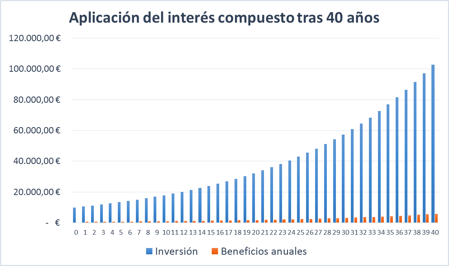
Para ver el razonamiento que subyace a este fenómeno matemático que resulta tan rentable en el largo plazo, imaginemos que invertimos 10.000 euros a una rentabilidad del 6%; consecuentemente, al cabo de un año veremos que obtendremos 10.600 euros (10.000 x 1,06).
Ahora, supongamos que, en lugar de retirar los 600 euros obtenidos, decidimos mantenerlos un año más. Con la misma rentabilidad anterior, el 6%, su inversión crecerá hasta los 11.236 euros (10.600 x 1,06) para el final del segundo año. Esto se debe a que se reinvirtieron los 600 euros y, junto a la inversión inicial, se obtuvo un beneficio adicional de 636 euros, 36 euros más que el año anterior. Este pequeño extra puede parecer insignificante, pero no nos olvidemos de lo más importante: esos 36 euros también tienen la capacidad de generar una rentabilidad futura.
“La principal virtud del interés compuesto puede aumentar significativamente la rentabilidad de las inversiones a largo plazo”
En un tercer año, el valor de la inversión sería de 11,910.16 euros (11.236 x 1,06). En este año se obtuvo 674,16 euros de beneficio adicional, lo que supone 74,16 euros más que el primer año. Este aumento anual de la cantidad se acelera año tras año, siempre y cuando se mantenga la reinversión.
Transcurridos cuarenta años, los beneficios anuales han evolucionado desde los 600 euros hasta los 5.822,40 euros en el último año. A lo largo del período analizado, con una rentabilidad del 6% anual sobre la inversión, los 10.000 euros iniciales se han convertido en 102.857,18 euros.
Una leyenda que explica cómo influye en interés compuesto
Cuando se invierte, siempre hay que tener en cuenta que el factor interés compuesto amplificará el crecimiento de su dinero en el futuro, pero recordemos que los pilares principales son el factor tiempo y la reinversión de los beneficios, por lo que la alteración de estas variables modificará finalmente los resultados.
Asimismo, existe una famosa leyenda sobre el origen del ajedrez vinculada al interés compuesto y a la comprensión del mismo. Cuando el inventor del juego le enseñó al emperador de la India el ajedrez, el emperador quedó tan impresionado que le dijo que le concedería cualquier recompensa que deseara.
“Descubre una famosa leyenda sobre el origen del ajedrez vinculada al interés compuesto”
El inventor le respondió al emperador lo siguiente: “Mis deseos son sencillos, emperador. Dame un grano de arroz por la primera casilla del tablero, dos granos por la siguiente, cuatro para la tercera, ocho para la cuarta y así, sucesivamente, hasta completar las 64 casillas del tablero”.
El emperador, extrañado del deseo aparentemente tan modesto del inventor, se lo concedió y dio órdenes a su tesorero para que abonase el pago de manera inmediata. No obstante, este último, tras calcular la cuantía, se dirigió al emperador aterrado y le comunicó que era imposible satisfacer el pago… ¿Cuánto estaba pidiendo el inventor del ajedrez?
Los cálculos son sorprendentes y se aprecia de manera clara la efectividad del interés compuesto en el largo plazo… Solo en la casilla 64, la cifra era de 9.223.372.036.854.780.000 granos de arroz, alrededor de 614.891,4 millones de toneladas. Sumando todas las casillas del tablero de ajedrez, ¡la cifra ascendía a 1,2 billones de toneladas! Para hacernos una idea de lo que el inventor estaba pidiendo, en el año 2012 la producción mundial de arroz fue de 731,2 millones de toneladas, por lo que se hubieran necesitado 1.641 años de la producción mundial para satisfacer los deseos del inventor del ajedrez.
¿A que ahora te llama más la atención interés compuesto?
Esto es lo que te tienes que fijar, los años que tardas en doblar tu inversión:
PD2: El cristiano entra en la iglesia para amar a Dios y sale para amar al prójimo…

02 diciembre 2016

¿miedos al proteccionismo de Trump?

El freno a la globalización no es de ahora, llevamos unos cuantos años que la importancia del comercio global es menor:
Quizás no sea para tanto… Desde Bruegel dicen:

Trump could give new impetus to EU-China relations

It is too early to say what the Trump administration’s trade policy will look like – but a total cut-off from Asian partners is unlikely. It would harm the US economy, and offer China even more scope to cement its position in Asia. Nevertheless, with TPP and TTIP both looking unlikely, the EU should move fast to build relationships with China and ASEAN countries.
Donald Trump’s presidency threatens isolationism and could cause the United States to turn away from Asia. Trump’s statements so far, from his dislike of the Trans-Pacific Partnership (TPP) to his threat to impose massive import tariffs on Chinese goods, seem to indicate that he wants to undo Obama’s pivot towards Asia and the current “cordial” US relationship with China. However, this is easier said than done. A US disengagement from trade with Asia would help, rather than harm, China, while a more aggressive approach to the bilateral relationship with China would risk undermining US interests.
The irony of Trump’s plan to dismantle TPP is that it is based on the belief that China would enter TPP through the back door at a later date and hurt US interests. However, China is probably relieved at the likely demise of TPP, a trade agreement that would hamper China’s trade relationships with its most natural trading partners in Asia. Not only that, China would be able to strike back with its own regional trade arrangements with Asian partners. China has already moved in this direction by launching the Regional Comprehensive Economic Partnership (RCEP) initiative with all key Asia-Pacific trading partners: Japan, Korea, Australia, New Zealand, India and the Association of Southeastern Asian Nations (ASEAN). These countries account for as much as one quarter of US exports. If the US reneges on TPP but the RCEP proceeds nevertheless, then US exporters will be put at a serious disadvantage. In addition, the US would miss the opportunity to promote its rules and values in Asia, such as strict labour, environmental and intellectual property protection standards. Such an institutional deficit will leave US firms less protected in Asian markets than they would be with a successful implementation of TPP.
Meanwhile, a unilateral increase in US tariffs on Chinese goods would disrupt the global production chain. Although China seems to be more vulnerable than the US because China imports less from the US than the US from China, both countries are now heavily integrated into the supply chain and any shock from either side would be reciprocally painful. With the potential further integration of Asia’s economies under RCEP, one of Trump’s key messages during his campaign – the repatriation to the US of manufacturing jobs –is not likely to happen because jobs might actually stay in a more regionally integrated and increasingly consumption-driven Asia. Even worse for the US would be if China were to actively retaliate. This could take many forms given the still relatively large stock of US FDI in China and the interests of US companies that aim to tap into China’s huge consumer market.
More generally, given Asia’s size in terms of both GDP and population, it is hard to believe that the US would just step back and watch China take its place in Asia. This is no longer as unlikely as Trump might have thought when making such statements. The production and trade structures of China and the ASEAN bloc are increasingly complementary: China mainly imports oil, gas and other raw materials from the ASEAN countries, whereas they import electronics and textiles from China. There is also a growing production chain linking China and ASEAN countries in which US companies are not necessarily involved. The ASEAN bloc is now China’s third largest trading partner, surpassing the European Union. As such, Asia’s further integration through trade agreements is in the interests of all partners.
Figure 1: geographical distribution of China’s trade and investment
Sources: OECD Bilateral Trade Dataset (left figure); Ministry of Commerce, People’s Republic of China (right figure).

However, China would not be completely satisfied with the idea of dominating Asia at the cost of losing the US market. A more practical possibility would be for the US – even under Trump – to cooperate with China in regional leadership among East Asian countries. Still, if Trump does keep his promises (no TPP, and barriers against China and perhaps others), China could cement its position in Asia and look beyond Asia to make up for the loss – namely, to Europe.
So, the most likely scenario is that many elements of the status quo hold: the Trump administration does not conclude TTP or TTIP successfully, but also does not impose protectionist measures on China because of the rebound effect on the US. Nevertheless, even in such a scenario where the US does not advance on regional trade agreements, China would have a first-mover advantage to China. Indeed, China’s rapid reactions to US hesitation over TPP during the last years of Obama’s administration sends a clear signal that China is unlikely to compromise with the US under a trade-adverse Trump. To our mind, Europe could be the next stop for China. This would be all the more logical given the hefty investment that China has planned –and started to carry out – for a much better connectivity with Europe under the Belt and Road Initiative.
As for the EU, closer economic relations with China might be the only call left in the absence of TTIP. The issue is more urgent against the backdrop of the potential RCEP agreement, whose members would account for about 30 percent of the EU’s external trade. If the EU cannot proceed with a favourable trade agreement with the region, its firms would also face trade diversion and enjoy less market access compared with other countries in the region such as China. In fact, the EU launched a plan to negotiate with the ASEAN countries in 2007 but the talks have moved to specific bilateral negotiations and progressed very slowly. Until now, out of the 10 ASEAN members the EU has only concluded free trade agreements with Singapore and Vietnam. Neither agreement has yet come into force. At the current juncture, with Asia-Pacific countries moving towards trade and investment integration, it is the time for the EU to speed up and rethink its strategy. The aim should be to reach a regional agreement with Asia-Pacific countries in which China plays an important role.
In any event, for Europe to move away from its long – although increasingly fruitless – transatlantic alliance towards China, it is vital to build real trust. This is even more important than railway connections. However, trust is currently at a low level, after the recent antidumping calls by the European Commission and China’s lack of reform to sectors over capacity. However, an inward looking, erratic and/or aggressive Trump administration might be the catalyst for a rapid increase in trust between the EU and China. In any case, the chances are that EU-China trade relations will improve under Trump.
Abrazos,
PD1: Hay cosas que claman por sí solas. En el sector de fabricación de coches, el precio de la mano de obra importa. Y los países emergentes, con sus bajos costes, son capaces de producir coches mucho más baratos, para satisfacer su demanda:
Y los fabricantes de teléfonos móviles sucumben ante el alza imparable de los fabricantes chinos:
PD2: Los socios comerciales británicos y estadounidenses son clave para la Unión Europea:
Y sin embargo, quizás Trump se contente con ser la economía que mejor ha salido desde la crisis de deuda de 2008:
Gracias en parte a que allí se ha invertido y no tanto en Europa:
PD3: El otro día leía esto: “Los enemigos realmente no te odian, se odian a ellos mismos porque tú eres el reflejo de todo lo que ellos quisieran ser". Y me paré a pensar si me veía reflejado. No, creo que no tengo enemigos, casi seguro estoy. Sí, sé que muchos pensáis que soy bastante rarito por contarte tantas cosas de mi intimidad. Pero dudo que haya nadie que le gustaría hacer lo que yo hago, o ser como yo soy… Intuyo que tengo a varios que chismorrearán de mi, hay tanta afición a meterse unos con otros que seguro soy su víctima, aunque poco me importa… Creo que les sigo queriendo.
Y esto que escribo no es para que otros me copien haciendo lo propio, sino que empecé pensando en mis hijos y en poder enseñarles algo de inversiones y de la vida misma…, algo de mí, por si les vale.

01 diciembre 2016

subirá más el SP500

Wall Street tiene enfrente otro posible tirón hasta los 2400 del SP500. El que haya ganado Trump, y vaya a implementar políticas fiscales generará subidas a corto plazo de los mercados, hasta mitad de año 2017. Luego la segunda parte será otro cantar…, pero lo iremos viendo. Según Goldman Sachs:
Having warned for nearly all of 2016 that the market is getting ahead of itself on the back of median P/E multiples that are higher than 99% of all historical reading, Goldman chief strategist David Kostin stubbornly kept his year end S&P target at 2,100 on valuation concerns.
Today, however, with oil soaring and the S&P at all time highs, he finally threw in the towel as a result of the Trump victory, and in a report Kostin writes that the Trump “Hope” will dominate through 1Q 2017 as S&P 500 climbs by 9% to 2400.  However, at that point, "less-than-expected tax cuts and higher inflation and interest rates will limit both upward EPS revisions and any P/E multiple expansion. S&P 500 will end next year at 2300, reflecting a price gain of 5% and a total return of 7% including dividends."
Here is the summary from Goldman:
+ US equity investors have focused “more on hope than n fear” since Donald Trump’s election. Ironically, many commentators believe his campaign rhetoric focused “more on fear than hope.” In 2017, we expect the stock market will be animated by competing views of whether economic policies and actions of President Trump and a Republican Congress instill hope or fear.
+ “Hope” will dominate through 1Q 2017 as S&P 500 climbs by 9% to 2400. The inauguration occurs on January 20 and our Washington economist expects much legislation will be proposed during the first 100 days. The prospect of lower corporate taxes, repatriation of overseas cash, reduced regulations, and fiscal stimulus has already led investors to expect positive EPS revisions. Instead of our baseline adjusted EPS growth of 5% to $123, growth could accelerate to 11% and reach $130, which would support a P/E multiple above 18x. Top “Hope” investment recommendations: (1) Cyclicals vs. Defensives; (2) Stocks with high US versus foreign sales exposure; and (3) High tax rate companies.
+ “Fear” is likely to pervade during 2H and S&P 500 will end 2017 at 2300, roughly 5% above the current level. Our economists expect inflation will reach the Fed’s 2% target, labor costs will be accelerating at an even faster pace, and policy rates will be 100 bp higher than today. Rising inflation and bond yields typically lead to a falling P/E multiple. Congressional deficit hawks may constrain Mr. Trump’s tax reform plans and the EPS boost investors expect may not materialize. Potential tariffs and uncertainty around other policy positions may raise the equity risk premium and lead to lower stock valuations in 2H. The median stock trades at the 98th percentile of historical valuation based on an array of metrics. Top “Fear” investment recommendations: (1) Low vs. High labor cost companies; and (2) Strong vs. Weak Balance Sheet stocks.
+ Money flow represents a potential upside to our baseline forecast. Equity mutual fund and ETF inflows may benefit as investors lose money owning bonds. After years of active management underperformance and outflows, higher return dispersion will increase the alpha opportunity for investors skilled enough to capture it. Economic policy uncertainty and the later stages of the economic cycle are typically associated with higher stock return dispersion
And the details which, among other things, include a discussion of Alexis de Tocqueville:
1. Earnings. S&P 500 operating EPS will grow by 10% to $116 in 2017 and adjusted EPS will increase by 5% to $123. Investors are excited about a prospective cut in corporate taxes that could boost adjusted EPS to perhaps $130, representing growth of 11%. However, our economists are skeptical that all the anticipated tax cuts will take place given the federal budget deficit constraints. Some tax reform will take place and upside exists to our baseline EPS forecast but it will be less than many investors now expect.
2. Inflation and interest rates. In terms of inflation, core PCE will reach the Fed’s 2% objective by the end of next year. The Fed will hike interest rates next month and three additional times in 2017. Ten-year US Treasury yields will rise to 2.75%.
3. Valuation. S&P 500 currently trades at 19x our forward top-down operating EPS estimate, 18x our forward top-down adjusted EPS and 17x our upside adjusted EPS scenario. The market trades at 17x forward consensus bottom-up adjusted EPS. US equities are highly valued relative to history on most metrics and versus inflation and interest rates. We forecast static valuation during the next 12 months.
4. Path and target. We expect the S&P 500 index will rise to 2400 (+9%) by the end of 1Q as investors embrace the possibility that lower taxes will lead to positive EPS revisions. But less-than-expected tax cuts and higher inflation and interest rates will limit both upward EPS revisions and any P/E multiple expansion. S&P 500 will end next year at 2300, reflecting a price gain of 5% and a total return of 7% including dividends.
5. Buybacks and dividends. Buybacks will rise by 30% as companies repatriate cash held overseas. Dividends will rise by 6% in 2017, above the 4% growth rate currently implied by the dividend swap market.
6. “Hope” vs. “Fear” strategies: “Hope” will dominate during the first part of 2017 as Cyclicals beat Defensives. Firms with high domestic sales will outperform along with companies with high tax rates. “Fear” will dominate later in the year when investors focus on rising inflation and interest rates. Low labor cost and strong balance sheet firms will outperform.
And the charts:
Y sin embargo, los EEUU no están como estuvieron en los 80. Mira que cacho diferencias:
Y la expansión última ha sido más parca:
Aunque los números de desempleo son falsos, como en España, ya que se desapuntaron muchos nuevos al mercado laboral al quitarse las expectativas de colocarse…
Veremos si son capaces de que su industria y la enorme sobrecapacidad no les afecte…
Ya que con la globalización, la industria está en Asia, ésta es nuestra apuesta:
Y solo con estímulos fiscales seremos capaces de seguir creciendo al mismo ritmo:
Aunque la subida no debe ser rectilínea, debe respirar ya que desde las elecciones no lo ha hecho. Si quieres entrar no te precipites ya que habrá que aprovechar algún recorte. Recuerda el acumulado de muchos años que es muy elevado. Abrazos,
PD1: Ayer la OPEP corto su producción y el precio del petróleo voló por encima de los 50 dólares… Malo para la inflación, pero muy bueno para el primer productor de petróleo que es EEUU, que produce más que Arabia Saudí con el fracking… Malo para España que importamos todo.

Why OPEC is trying to cut back on oil production — after doing nothing for two years

For the past two years, as oil prices have been plummeting worldwide, OPEC has mostly stood by and watched, unable to reach a decision on how to react.
The cartel's most important member, Saudi Arabia, famously refused to cut output in 2014when prices first began sliding, because officials were hoping the resulting price crash would drive large swaths of the US fracking industry — with its higher production costs — out of business. The fracking boom in North Dakota and Texas, after all, was a big reason the oil market was oversupplied.
“At the time, that decision to let oil prices drop made sense,” explains Jason Bordoff, founding director of Columbia University’s Center on Global Energy Policy. At the time, Saudi Arabia didn’t want to cut back on production and lose market share only to see other producers reap the benefits — a “historic error” the country made when prices fell in the early 1980s.
But the world has changed a lot over the past two years. US production has fallen from 9.6 million barrels per day down to 8.6 million barrels per day amid the price crash. Nearly $1 trillion in oil investment worldwide has dried up. Iran returned to the oil market after EU and US sanctions were lifted as part of the nuclear deal. Meanwhile, Saudi Arabia has been hurt badly by the price crash. The country has already burned through $160 billion worth of foreign exchange reserves and has been forced to cut social services and salaries to compensate for lower oil revenues, threatening stability in the kingdom.
So the Saudis finally decided to shift their stance. Back in September, OPEC’s 14 members agreed to set a short-term ceiling on their overall output between 32.5 million and 33 million barrels per day. The hope was that by cutting output, OPEC countries could boost prices and ease the pain on their budgets without immediately triggering a massive surge in new oil investment that would lead to another glut and crash.
PD2: Es la segunda derivada, contemplar…
Hay una gran diferencia entre observar y contemplar. Con frecuencia observo la vida. Lo que sucede delante de mí. Lo analizo, lo disecciono, y decido lo que está bien y lo que no corresponde. Me indigno con lo que no comparto. Quiero cambiarlo. Me emociono con lo que toca mi alma. Quiero alterar la disposición de las cosas. Eliminar algunas, introducir otras nuevas. Tengo una tendencia natural a observar lo que sucede y después actuar. Miro, pero no contemplo.
Me cuesta más estar sencillamente contemplando lo que tengo en frente, admirándome de su belleza, sin hacer nada.
El otro día leía: “Si uno observa quiere saber y obtener información. Uno quiere conseguir algo, por ejemplo conocimiento. En cambio el mero contemplar no pretende conseguir nada. La actitud contemplativa nos conduce a una increíble calma. Todo lo que está presente puede estar presente. No necesitamos cambiar nada. Lo dejamos todo como está. Contemplando se llega al amor por lo contemplado. La contemplación es desinteresada y libre de intereses propios. Así, nunca desearíamos que Dios nos observara, pero somos felices cuando nos contempla bondadosamente. En la vida eterna tampoco observaremos a Dios, sino que lo contemplaremos y por eso lo amaremos”.
Me gustaría aprender a vivir así. Y sacar paz de todo lo que veo. Detenido ante la vida llenarme de la presencia de Dios. Sé que todo me habla de su amor, de su preocupación por mí. Quiero que Dios me contemple.
Quiero contemplar a Dios y saber lo que me está diciendo en medio de mis días. No sólo donde creo que Dios sí me tiene que decir algo.